
Is Your Herbal Label Compliant? FSSAI Advisory 2026
Inspeckt Food Solutions
FSSAI's Botanicals Advisory: What Brands Using Herbs Need to Check Now
On 15 October 2026, FSSAI's Regulatory Compliance Division issued an advisory titled "Mandatory Compliance with Labelling Requirements and Warning Statements for plant and botanical ingredients and their extracts". It says several food business operators making nutraceuticals, health supplements, food for special dietary use and food for special medical purposes are not following the labelling requirements and warning statements prescribed under Schedule IV of the 2016 Regulations.
If your product has a herb, root, leaf, seed or flower extract in it, this is worth an hour of your week. The rules are not new. What has changed is that the regulator has said, in public, that it is looking at exactly this.
Here is how to work through it: what kind of product you have, how to use botanicals correctly, what goes on the pack, and what you can say about it. And if you'd rather not do it alone, come and talk to us. We'll go through your labels and formulations with you.
Step 1
Which lane is your product in?
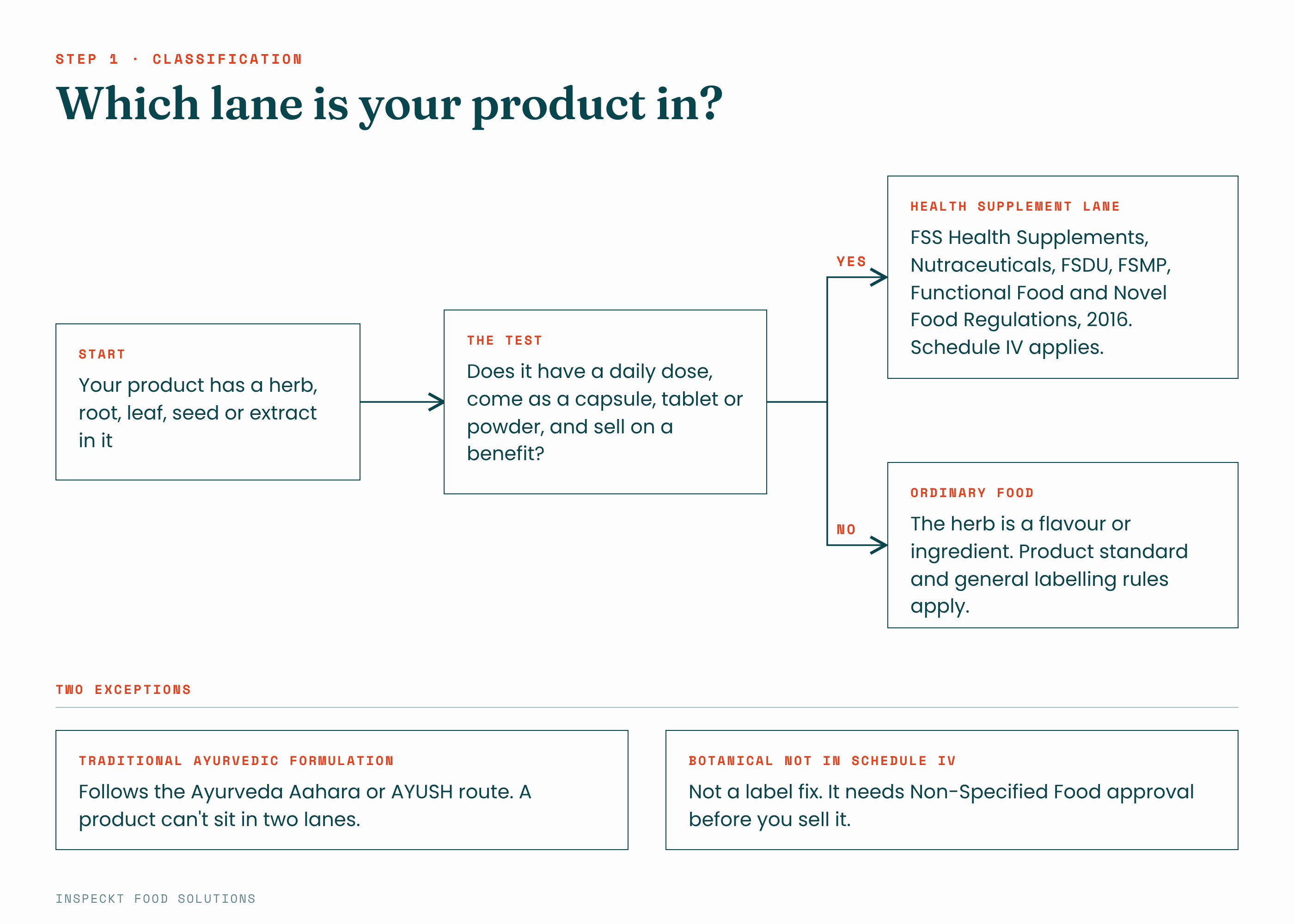
Everything else depends on this, and brands often assume the wrong lane. The simple check: does the product have a daily dose, come as a capsule, tablet or powder, and sell on a benefit? If yes, FSSAI will treat it as a health supplement or nutraceutical, whatever name is on the pack. If the herb is just a flavour or an ingredient in an ordinary food, such as a tea or a snack, it follows the product standard and the general labelling rules.
Step 2
Using botanicals in a product
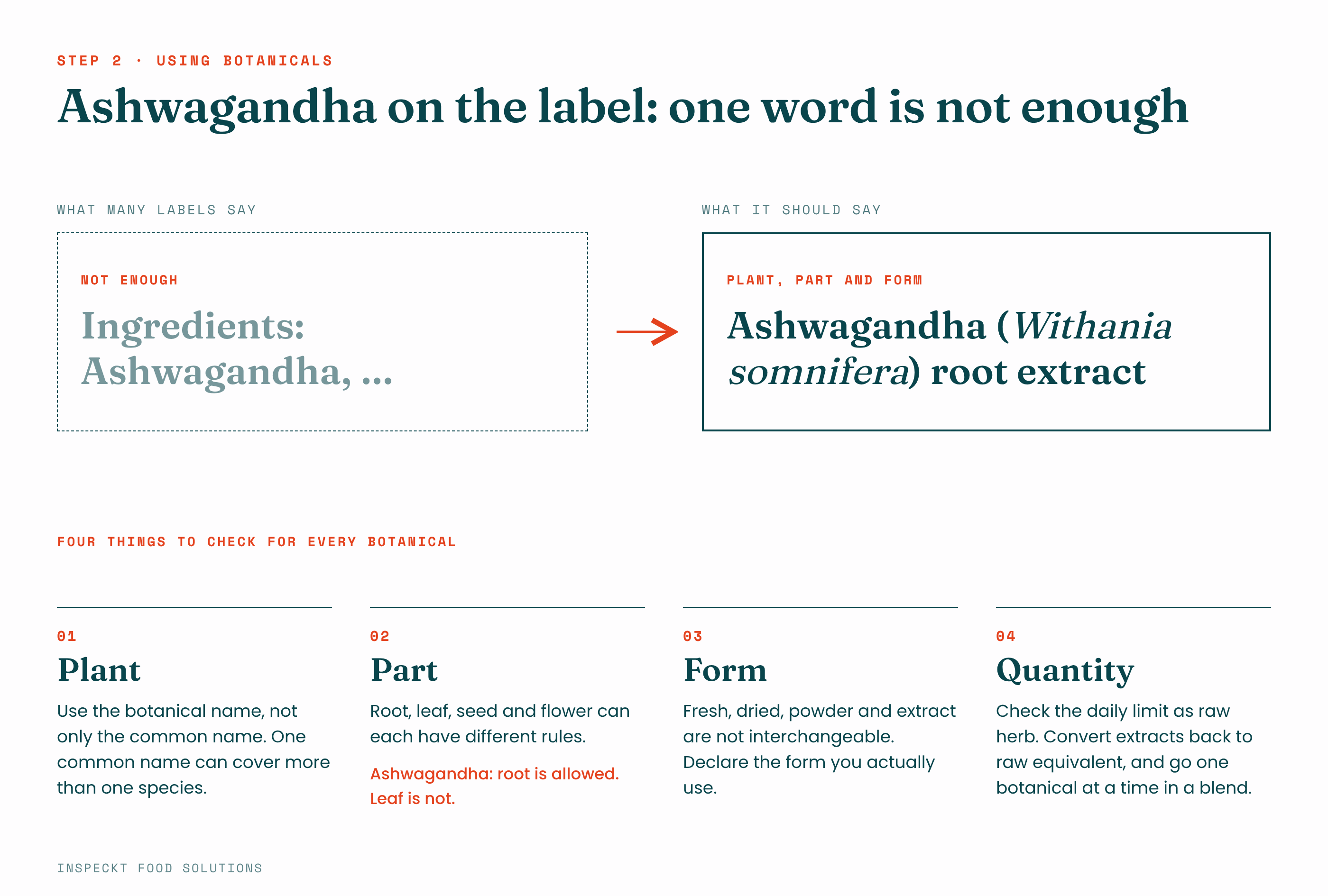
A very common mistake I see in the market right now: brands simply write "ashwagandha" on the label. Only the root is permitted, not the leaf. So just writing ashwagandha tells nobody which part you used. You have to declare exactly what you are using, the form and the botanical name as well.
Same plant, two answers
One part is allowed. One is not.
Writing only "ashwagandha" on a label does not say which part is in the pack.
Leaf
For every botanical, check four things: the plant, the part, the form and the quantity. The graphic shows how this looks for ashwagandha. Ashwagandha is not one of the 16 botanicals in this advisory's annexure, but the same logic applies to every botanical you use.
What Annexure I actually lists
The advisory comes with Annexure I, prepared in consultation with the Ministry of Ayush. It lists 16 botanicals where a declaration and cautionary statement are mandatory, with the permitted adult daily range given in terms of raw herb or material. The full table is at the end of this article.
These are the permitted ranges for regulated products. They are not recommendations for personal use. Not being on this list does not make a botanical free to use: it still has to be permitted under Schedule IV.
Twelve of the 16 carry a caution for children under five, and eight carry one for pregnancy.
If your product is aimed at kids or at pregnant women, this is the first place to look. The limits also differ a lot from one botanical to the next, which is what the next graphic shows.
Annexure I · Daily limits
Same scoop. Different verdict.
Drag the slider to change how much raw herb goes into one day's serving. Each tile shows the adult daily range FSSAI lists for that botanical.
SOURCE: FSSAI ADVISORY DATED 15 OCT 2026, ANNEXURE I. ADULTS, RAW HERB. NEEM AND PAPAYA APPEAR TWICE BECAUSE THEY HAVE TWO LISTED PARTS.
That is why every botanical needs its own check. A 3 g serving that is fine for one herb is already over the limit for another.
Allowed and not allowed, at a glance
| Allowed | Not allowed |
| A botanical listed in Schedule IV, in the listed part, form and daily quantity | A botanical outside the list, sold without approval |
| The prescribed warning, printed clearly | A different part than the one permitted, for example leaf where only root is allowed |
| Plant, part and form declared properly | A missing, tiny or hidden warning |
| Food language on pack, website and social | Any line that says the product treats, cures or prevents a disease |
Step 3
What goes on the pack
The advisory sits on top of the usual labelling rules, and points to the labelling provisions across the 2016 Regulations (regulations 3(13), 4(2), 6(2)(i), 7(2)(i), 7(3)(v), 8(2)(i), 9(2)(i), 12(1)(i), 12(2) and 12(3)(i) to (iii)). For a product with a listed botanical, check these:
The plant part used. The advisory directs manufacturers to indicate it on the label.
The prescribed cautionary statement for each relevant botanical: pregnancy, planning to conceive, children under five. Two warnings apply if two of your botanicals need them.
Recommended daily usage, so the consumer is not left guessing how much is too much.
The standard statements for your category. Confirm the exact wording against the regulation for your category instead of copying a competitor.
Visibility. The warning has to be easy to see and read. Tiny type on the back flap, in a colour that disappears into the background, is exactly what gets picked up in a label review.
The rest of the pack: FSSAI licence number and logo, veg or non-veg mark, net quantity, batch and date marking, manufacturer or marketer details, nutrition information.
Now try it on a label. Here is an invented pack with five problems, the kind we see in label reviews.
Spot the mistakes
Five problems on one label
An invented product, made up for this exercise. Tap the numbers to see what is wrong and how to fix it.
Step 4
Advertising and claims
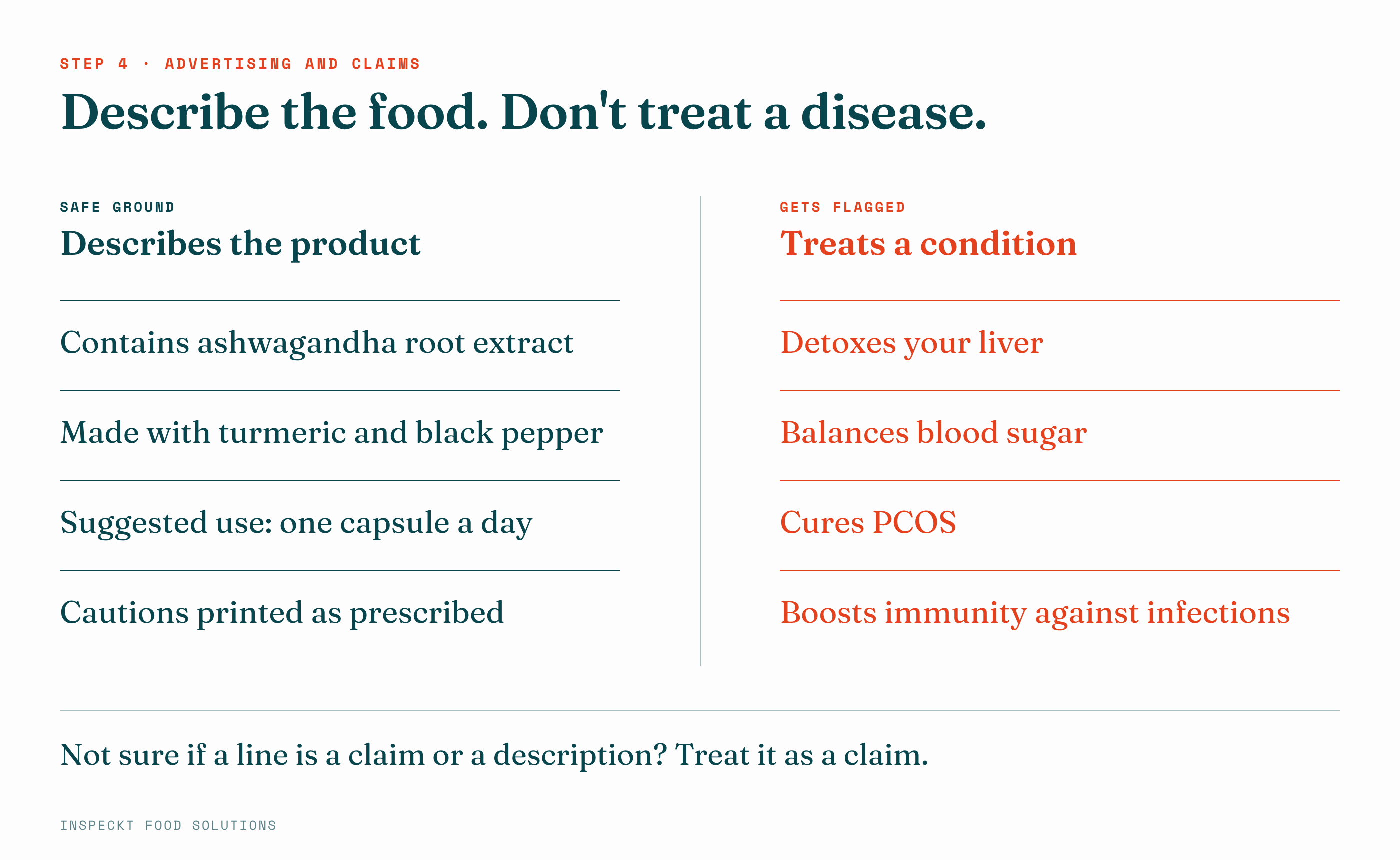
This is where most of the risk sits, because it is the part brands write themselves. The advisory reminds FBOs that the regulations prohibit any medicinal claim or suggestion of disease cure. That matches what already applies:
FSS (Advertising and Claims) Regulations, 2018. Claims must not be false, misleading or deceptive, and must be backed by evidence.
Drugs and Magic Remedies (Objectionable Advertisements) Act, 1954. Restricts advertising that claims to cure or prevent a listed set of conditions. Herbal does not exempt you.
Other places brands get caught:
Influencer posts and reels. They count as your advertising even when the creator wrote the script.
Using a traditional text or an animal study as the basis for a human health claim.
Calling a product "natural" or "100% pure" when the formulation says otherwise.
Before and after images, testimonials about disease outcomes, and doctor endorsements.
One more place where brands slip: online listings. Your Amazon, Blinkit or own-website page should carry the same declarations as the pack. A listing that quotes benefits the label does not make is a gap an inspector can point to.
What happens if you do not comply
The advisory says non-compliance is a violation of Section 23 of the Food Safety and Standards Act, 2006, which covers packaging and labelling, and will attract stringent action under Section 52, the provision for misbranded food. Under the Act, that penalty can go up to ₹3 lakh. The advisory also says FBOs can face suspension or cancellation of their licences. It asks for compliance now, because the requirements underneath it already exist.
Where to start this week
List every product that contains a plant, herb, seed, flower or extract. Include blends and flavours.
For each botanical, write down the plant, part, form and daily quantity. Convert extracts to raw equivalent.
Match each one against the official Annexure I and Schedule IV, and mark the warnings required.
Read your pack, website, marketplace listings and social posts the way a regulator would. Take down anything that sounds like treating a disease.
Keep the paperwork: formulation sheet, supplier specification for plant part and species, label sign-off.
Keep the signed advisory on file (F. No. RCD-02004/7/2025-Regulatory-FSSAI, dated 15 October 2026) and work from it. Limits and warning wording are exact.
Annexure I in full
Taken from the advisory dated 15 October 2026. Daily limits are for adults, in terms of raw herb or material.
| Botanical | Part | Daily limit for adults (raw herb) | Not recommended for |
|---|---|---|---|
| Neem (Azadirachta indica) | Leaf | 1–3 g, as powder | Males and females planning to conceive |
| Neem (Azadirachta indica) | Fruit | 1–2 g, as pulp | Planning to conceive; children below 5 years |
| Papaya (Carica papaya) | Unripe fruit | 30–50 g | Pregnancy |
| Papaya (Carica papaya) | Leaf / juice | 5–10 g/ml, for decoction | Pregnancy |
| Bimbi / Kundru phal (Coccinia grandis) | Leaf | 5–10 g | Children below 5 years |
| Coffee (Coffea arabica / C. robusta) | Seed, dry or green | 3–5 g | Children below 5 years |
| Gandiva / Pathachoor (Coleus forskohlii) | Root, leaf or whole plant | 3–5 g, as powder | Children below 5 years |
| Carrot (Daucus carota) | Seed | 1–2 g, as powder | Pregnancy |
| Snuhi / Thuhar (Euphorbia neriifolia and related) | Leaf | 3–5 g, as fresh | Children below 5 years; pregnancy |
| Hibiscus (Hibiscus rosa-sinensis) | Flower | 1–3 g, as powder | Pregnancy |
| Shankhini (Ipomoea nil) | Seed | 3–5 g, as fresh | Children below 5 years; pregnancy |
| Garden cress / Chansur (Lepidium sativum) | Seed | 3–6 g, as powder | Pregnancy |
| Trivrat / Nishoth (Operculina turpethum) | Root or seed | 1–3 g | Children below 5 years |
| Betel / Tambula (Piper betle) | Leaf | 2–5 g | Children below 5 years |
| Chitraka (Plumbago zeylanica) | Root | 1–2 g, as powder, after purification | Children below 5 years; pregnancy |
| Putrajivak (Putranjiva roxburghii) | Fruit seed kernel | 3–6 g | Children below 5 years |
| Ambat chukka (Rumex vesicarius) | Leaf | 10–20 g | Children below 5 years |
| Inder vaaruni (Trichosanthes bracteata) | Root or fruit | 0.5–1 g, as powder | Children below 5 years; pregnancy |
Inspeckt Food Solutions reviews food claims, brand names, and labels for FSSAI compliance before they go to print, not after. A detailed claims and label review starts at ₹,5,000 per SKU.
Have a packaging run coming up? Get the claim checked first.
Comments
No comments yet. Be the first to share your thoughts.
Add your thoughts
Contact usPrefer a call with our team? Use Contact us, or leave your email below if you want us to follow up on this comment.
Need help acting on this change? Ongoing regulatory compliance support means you hear about the updates that affect your products, with what to do about them.
Back to all updates