
What Makes Clear Whey Clear? Science, Manufacturing & Compliance
MANUFACTURING
I Discovered Clear Whey Last Year. Here's What I Learned.
A category quietly taking over India’s supplement market, built on one ingredient most people have never heard of: whey protein hydrolysate.
Diptasree · Founder, Inspeckt Food Solutions
Six months ago, I walked into my gym and saw something odd on the smoothie bar: a crystal-clear bottle labeled “clear whey isolate.” It looked like diluted juice, not protein powder.
As someone who audits supplement formulations, I wanted to understand the obsession. Why? How is it better than traditional whey protein powder? What I found is a category that’s quietly taking over India’s supplement market.
Many clear whey products are built on whey protein hydrolysate or specially processed whey protein isolate, depending on the manufacturer's process.
Whey Isolate vs. Whey Hydrolysate: The One Difference That Matters
Most people think whey isolate is the end of whey processing. It’s not!
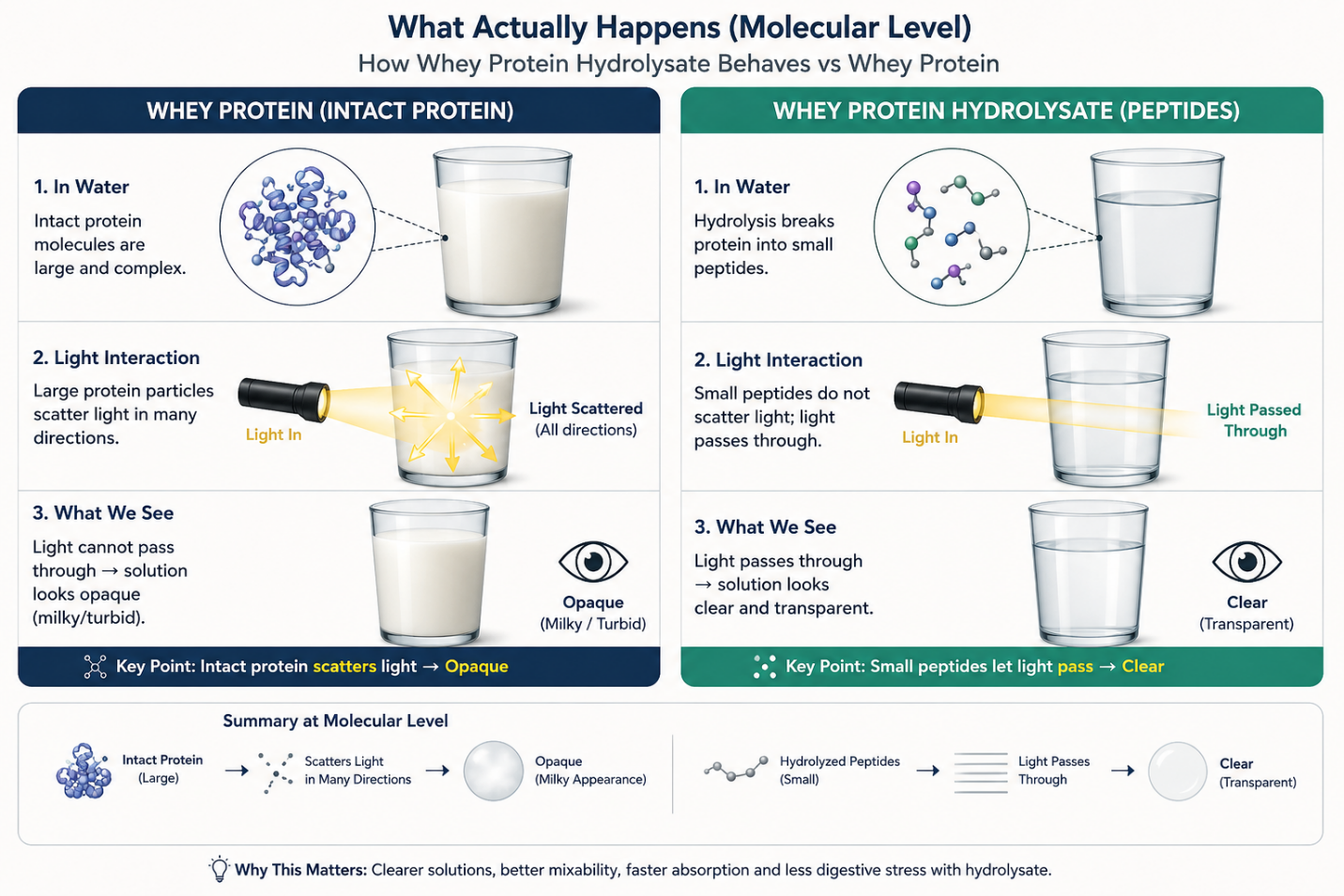
Traditional whey protein isolate (WPI) is produced using membrane filtration, yielding a protein content of typically ≥90% (dry basis) while preserving the native structure of the major whey proteins. These proteins, predominantly β-lactoglobulin (~18 kDa) and α-lactalbumin (~14 kDa), remain intact and can aggregate under certain conditions, increasing light scattering and producing the characteristic cloudy appearance of conventional whey beverages.
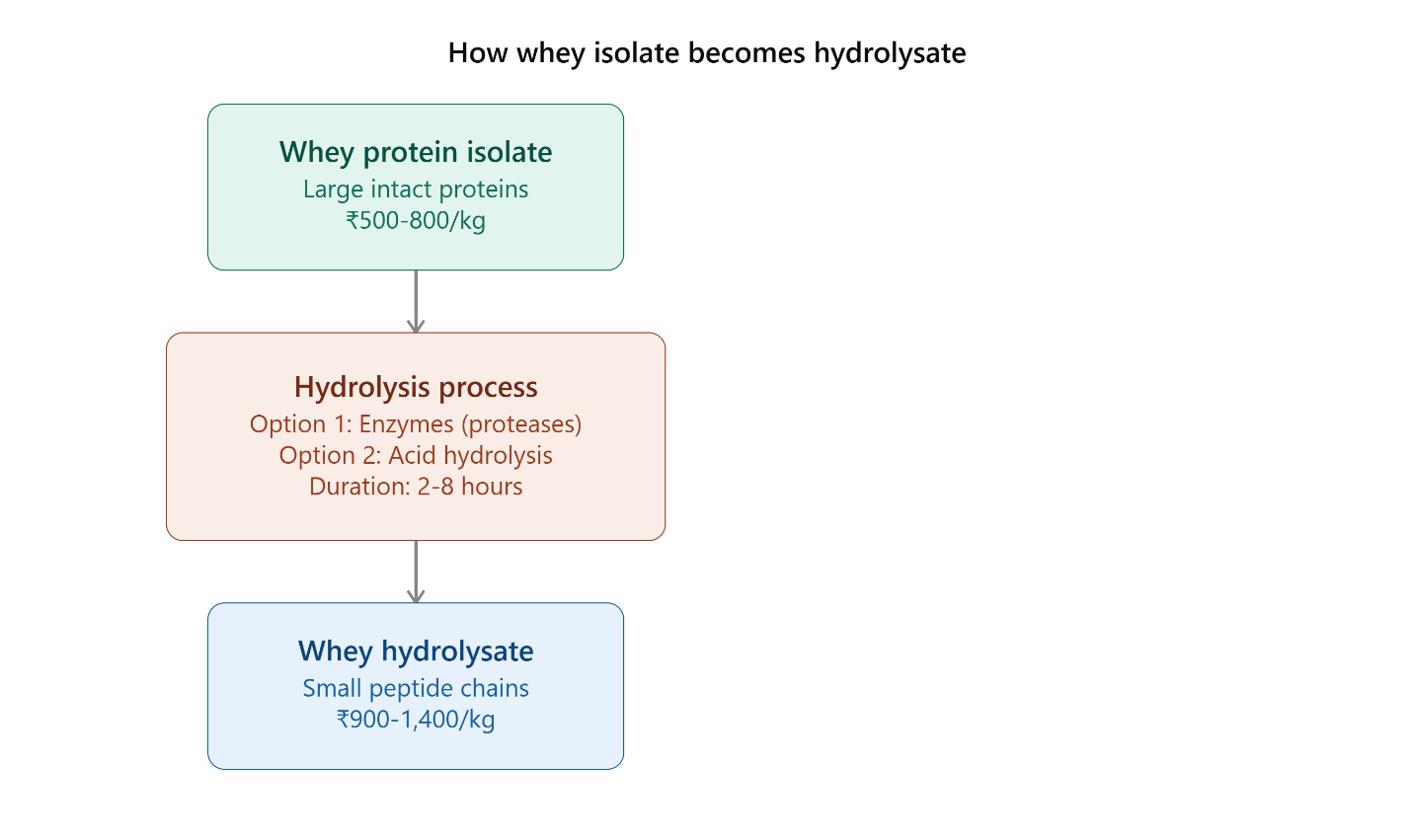
Many clear whey formulations use whey protein hydrolysate (WPH) or specially processed WPI. Hydrolysis cleaves intact proteins into lower-molecular-weight peptides, typically ranging from several hundred to a few thousand Daltons depending on the degree of hydrolysis (DH). The resulting reduction in protein aggregation, together with improved solubility, enables the formation of a clear beverage.
Clarity also depends on maintaining an acidic formulation (typically pH 2.8–3.8), where whey peptides remain highly soluble and resistant to precipitation. In this system, citric acid functions not only as an acidulant but also as a critical component in maintaining product clarity and stabilit
Diagram 1 · From isolate to hydrolysate
The Hydrolysis Process: Breaking Down Proteins
How it actually happens: two completely different methods.
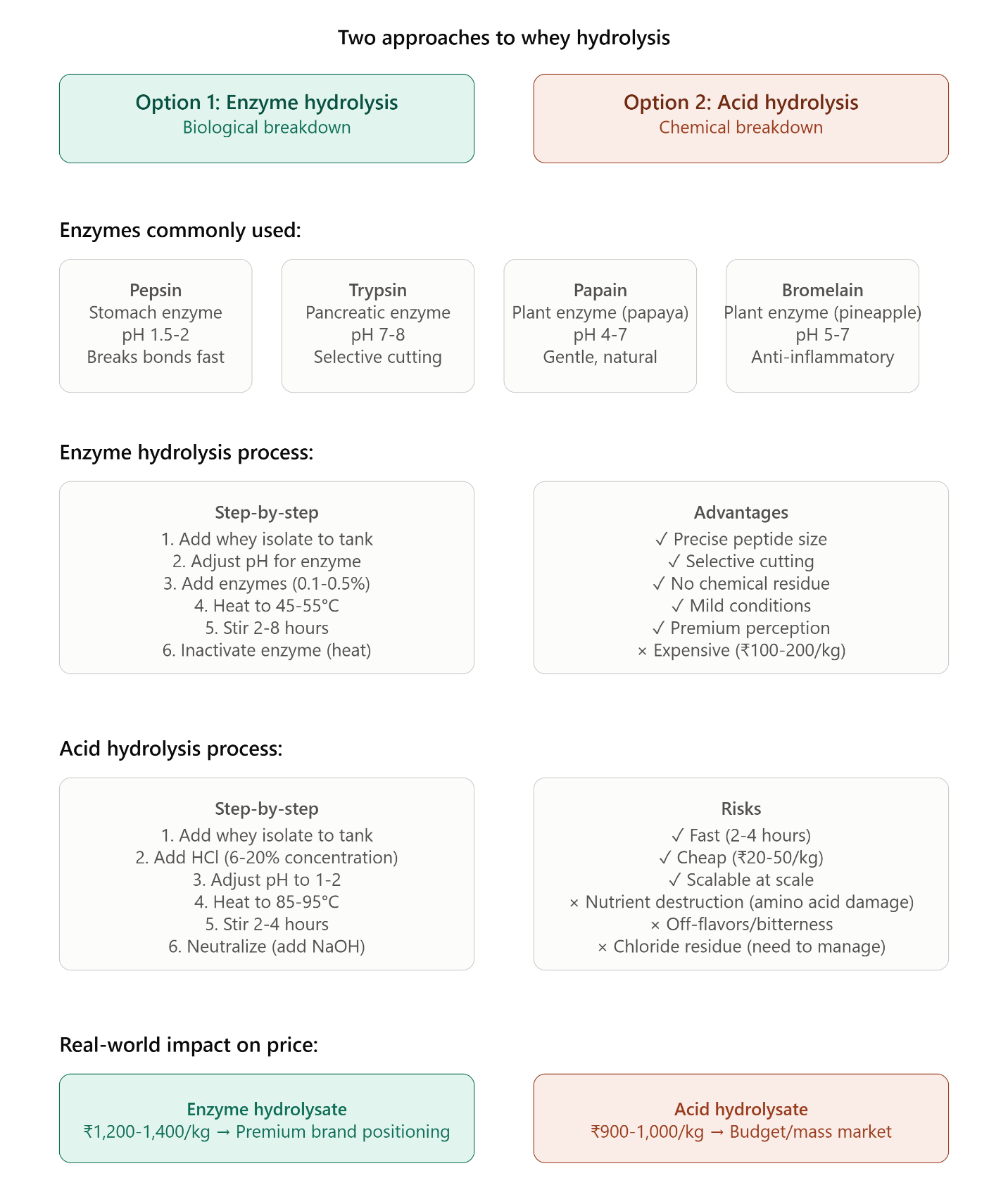
Option 1 · Enzyme hydrolysis (biological breakdown)
Specific enzymes are added to whey isolate. Each enzyme cuts protein bonds at different rates and locations:
| Pepsin | Stomach enzyme · pH 1.5–2 Broad proteolytic activity under acidic conditions |
| Trypsin | Pancreatic enzyme · pH 7–8 Selective, premium peptide control |
| Papain | Papaya enzyme · pH 4–7 Gentle proteolytic activity |
| Bromelain | Pineapple enzyme · pH 5–7 Proteolytic enzyme commonly used in food processing |
Option 2 · Acid hydrolysis (chemical breakdown)
Whey isolate is treated with concentrated hydrochloric acid under high heat and low pH.
• Process: add whey isolate to tank → add HCl (6–20%) to drop pH to 1–2 → heat to 85–95°C → stir 2–4 hours → neutralise with sodium hydroxide.
• Result: fast and scalable. Problems: damaged amino acids (tryptophan especially), bitter off-flavours, and chloride residue to manage.
Two approaches, side by side
| Option 1 · Enzyme hydrolysis | Option 2 · Acid hydrolysis |
|---|---|
| Step by step | Step by step |
| 1. Add whey isolate to tank | 1. Add whey isolate to tank |
| 2. Adjust pH for the enzyme | 2. Add HCl (6–20% concentration) |
| 3. Add enzymes (0.1–0.5%) | 3. Adjust pH to 1–2 |
| 4. Heat to 45–55°C | 4. Heat to 85–95°C |
| 5. Stir 2–8 hours | 5. Stir 2–4 hours |
| 6. Inactivate enzyme with heat | 6. Neutralise with NaOH |
| Advantages | Trade-offs |
| ✓ Precise peptide size | ✓ Fast (2–4 hours) |
| ✓ Selective cutting | ✓ Scalable |
| ✓ No chemical residue | × Nutrient destruction (amino acid damage) |
| ✓ Mild conditions | × Off-flavours and bitterness |
| ✓ Premium perception | × Chloride residue to manage |
Diagram 2. Two approaches to whey hydrolysis, side by side.
The Real Problem: Supply Chain, Not Formulation
Commercial-scale production capacity for high-quality whey protein hydrolysate remains relatively limited in India compared with Europe and North America. It requires enzyme systems, hydrolysis control equipment, and humidity-controlled spray drying that most Indian manufacturers don’t have.
So brands either import finished hydrolysate, import isolate and outsource hydrolysis, or partner with a manufacturer that has the capability. Each path needs certificates of analysis, food safety documentation, and lab testing on arrival, most brands don’t have that paperwork complete.
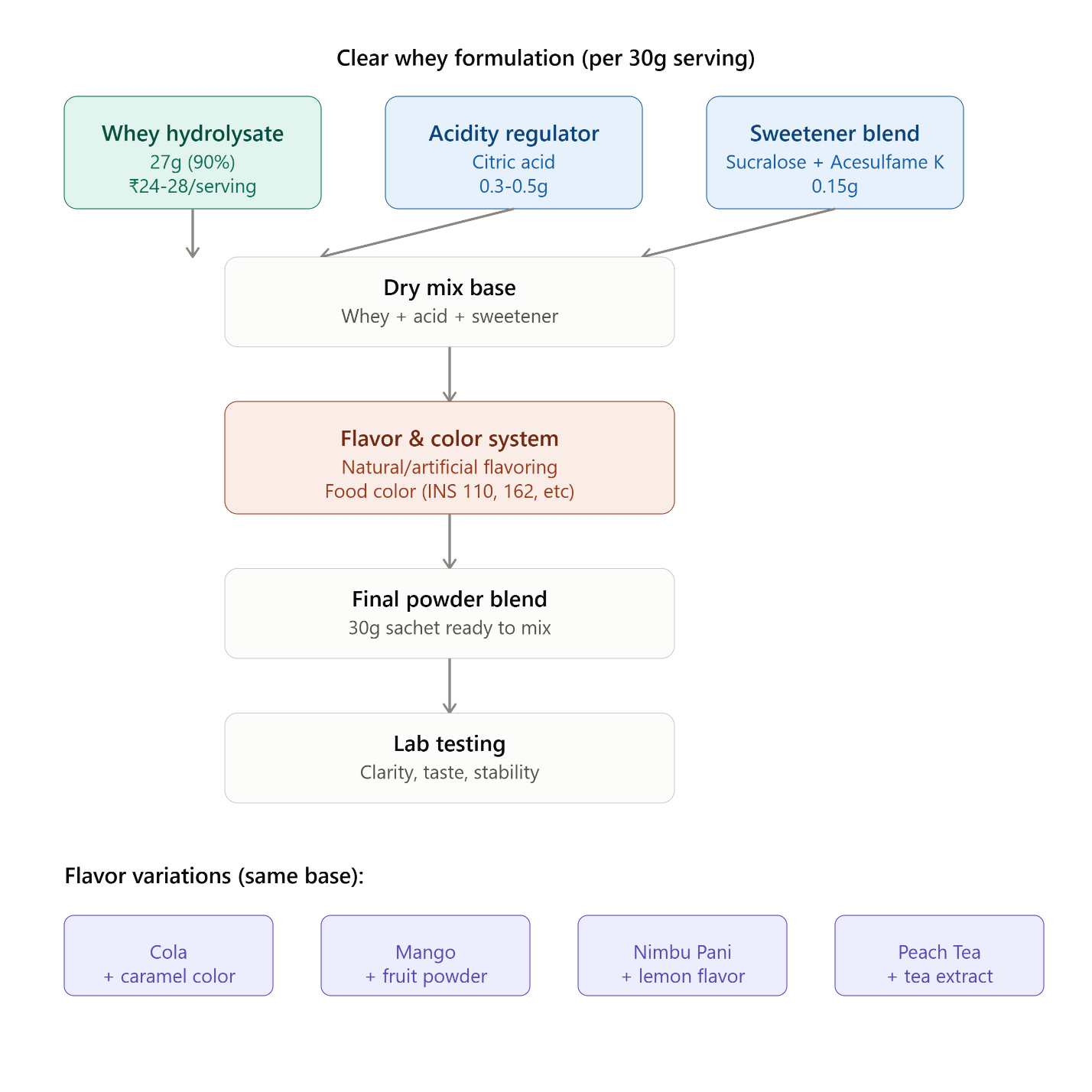
How Clear Whey Gets Made?
The formulation itself is simple: 90%+ whey hydrolysate, an acid regulator, a sweetener blend, and a flavour & colour system.
The Storage Problem That Kills Products
Hydrolysed whey absorbs moisture from air. In India’s climate, this is a real problem.
| Storage Method | Result |
|---|---|
| Basic warehouse | Cloudy, yellowing. Unsellable. |
| AC + desiccant | Stays clear through shelf life. |
| Humidity control + N₂ flush | Premium clarity throughout. |
Why This Matters
Clear whey’s growth isn’t a mystery. It’s execution discipline.
Brands winning at clear whey treat sourcing, documentation, storage, and testing as core to the business, not supply chain admin. The ones that don’t treat it that way build the brand story, get the positioning right, then watch the product turn cloudy on shelves or fail FSSAI compliance over incomplete paperwork.
The lesson isn’t formulation complexity. It’s the foundation: source good whey, document everything, store it properly, test obsessively.
Key Takeaways
For founders
• Check multiple manufacturers, and audit the facility before deciding your supplier.
• Humidity control decides whether your batch survives monsoon.
• FSSAI approval isn’t a checkbox. Approval timelines vary depending on the product category, documentation quality and regulatory queries. Complete documentation significantly reduces delays.
For the category
• Published market forecasts generally project steady global growth for the clear whey category through 2030, with Asia expected to be among the fastest-growing regions. In our view, there remains an opportunity for early movers that establish robust sourcing, documentation and quality systems.
• Premium positioning only holds where sourcing, documentation and storage discipline hold.
• Supply chain discipline wins. Corner-cutting on storage or documentation fails visibly, publicly.
Talk to our regulatory expert.Comments
No comments yet. Be the first to share your thoughts.
Add your thoughts
Contact usPrefer a call with our team? Use Contact us, or leave your email below if you want us to follow up on this comment.