
What Every Indian Food Brand Should Know About Dietary Fiber Right Now
The Fiber Reboot: What Every Indian Food Brand Should Know About Dietary Fiber Right Now
By Inspeckt Food Solutions
When we think about fiber we usually think about fruits, vegetables, whole grains and foods like isabgol but fiber is definitely no longer limited to these everyday food sources. The food industry is finding different ways to use fiber and this is slowly changing how food products are usually made and labelled.
In July 2026 the US FDA recognised Acacia gum which is also known as gum arabic as a fiber. The interesting part is that food companies have been using this ingredient in products like sweets, beverages, dairy products and meat products for years. However this recognition means that it is no longer limited to sweets or dairy products, it can now qualify for dietary fiber claims under the US requirements.
At first this might sound like a change. It tells us something really important about the food industry. Ingredients which were earlier used only to improve the texture or stability of food, are now getting attention for their possible nutritional benefits also.
For food brands, small or big, this is something worth understanding. If you are a food developer, developing a product or planning to update an existing label, you should know what counts as dietary fiber and what claims you can make.
Let’s look at what more is changing, which ingredients are becoming popular and what Indian food brands need to keep in mind.
Why Is Everyone Talking About Fiber Now?
Over the past few years people have become more interested in what they eat and how it affects their health. Protein was a focus for food brands for a long time and now fiber is getting similar attention too.
There are a few reasons behind this change, let’s look into them:
First, gut health has become a topic. More people are learning about the gut microbiome and how fiber supports digestion. There is also growing interest in the connection between gut health and other aspects of health although the benefits depend on the type of fiber and also the evidence available for it.
Second, weight management is influencing the way some food products are developed. With the growing use of GLP-1 medicines for weight management there is interest in foods that provide useful nutrients in smaller portions. Fiber can also help people feel full depending on the type and amount consumed.
Third, food companies now have options when it comes to fiber ingredients. Earlier the main focus was only on ingredients such as wheat bran and psyllium husk. Today companies are exploring different types of fibers that can be used in beverages, snacks, bakery products and other packaged foods.
This gives food brands choices but it also means they need to understand which ingredient works best for their product.
Understanding the Different Types of Fiber:
Fiber is usually divided into two categories: I) Soluble and II) Insoluble. Both are equally important. They behave differently in food and in the digestive system.
There are also categories, such as prebiotic fibers and resistant starch that food manufacturers should know about.
Soluble Fiber
Soluble fiber usually dissolves in water. Some types form a gel like texture, which can help slow digestion. Certain soluble fibers, such as oat beta-glucan can also help manage cholesterol levels when consumed in proper amounts.
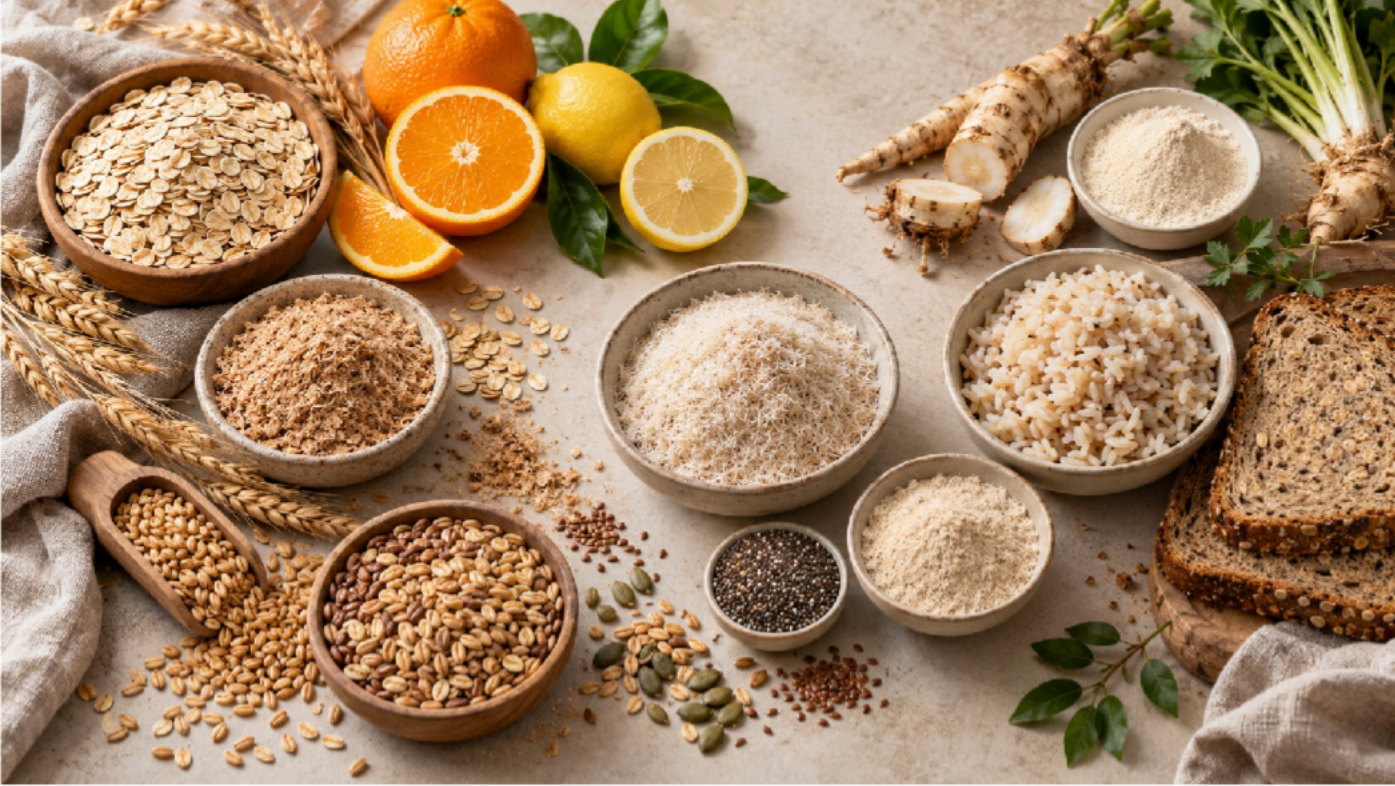
Common sources include oats, citrus fruits, psyllium and certain plant-based ingredients.
For food manufacturers, soluble fiber can be useful in beverages and dairy products because some types mix well with liquids without making the product too thick.
However not every soluble fiber behaves in the way. Its effect on texture, taste and stability depends on the ingredient being used.
Insoluble Fiber
Insoluble fiber does not dissolve in water like soluble fiber. It adds bulk to stool. It also helps support regular bowel movements.
Common sources are: wheat bran, grains and the skins of many vegetables.
This type of fiber is often used in bakery products, breakfast cereals and snacks. These products can sometimes handle the texture better than beverages.
For example adding fiber to a biscuit may be easier than adding the amount to a clear drink, where even a small change in texture can affect the final product.
Prebiotic Fiber
Prebiotic fibers are receiving attention because they can be used by certain beneficial microorganisms in the gut. Some familiar examples are fructo-oligosaccharides (FOS) and galacto-oligosaccharides (GOS).
Inulin and FOS are commonly obtained from sources such as chicory root. When developing products focused on gut health, GOS is another option that food manufacturers may consider.
These ingredients can be used in products such as nutrition bars, dairy products and beverages.
However brands should be careful when talking about their benefits. Not every prebiotic fiber has the effect and claims about immunity or other health benefits need suitable scientific evidence.
Starch
Resistant starch is another ingredient you should know. Although it is a type of starch, it is not fully digested in the intestine. Instead some of it reaches the intestine, where gut bacteria can ferment it.
It is being explored for use in products such as bread, pasta and other foods.
For manufacturers, resistant starch offers another way to increase the fiber content of a product. However adding it is not always as simple as replacing one ingredient with the another.
It can change the texture, taste and overall quality of the product. This means the recipe may need to be tested and adjusted before it is ready for the market.
Purified and Reclassified Fibers
This is where the Acacia gum story becomes interesting.
Some ingredients have been used in food manufacturing for a time mainly to improve texture, stability or thickness. Over time research and regulatory decisions may establish that certain ingredients also qualify as fiber under specific rules.
Acacia gum is an example of an ingredient that has received this recognition in the United States.
For food brands this creates possibilities. An ingredient that is already part of a product may have a nutritional role provided it meets the applicable requirements.
But this does not mean that every thickener or stabiliser can automatically be called fiber. Each ingredient must meet the scientific and regulatory requirements.
It is also important to remember that recognition by the US FDA does not automatically mean the ingredient qualifies for the same claim under Indian food regulations.
New Developments in Fiber Ingredients
The changes in the fiber industry are not about finding new plant sources. Companies are also working on ingredients that can solve problems during food production.

One example is dietary fiber.
Samyang Corporation introduced its Fibernova brand at IFT 2026. It is based on kestose, a type of fructo-oligosaccharide. Is designed as a high-purity prebiotic fiber.
According to the company’s product information it has a purity of over 99%. Provides some sweetness at around 30% of the sweetness of sugar while contributing very few calories compared with sugar.
This could be useful for the manufacturers who want to reduce sugar and increase fiber in the product. For example a company developing a beverage or gummy product may find such an ingredient worth exploring.
Of course the final result will still depend on the complete formulation and how the ingredient performs in the product.
Other developments are also worth watching. Some fibers are being designed to dissolve without making drinks too thick. Others are being developed to remain stable during processing or across acidity levels.
Food companies are also looking at products that combine protein and fiber. Instead of focusing on only one nutritional feature these products aim to offer more than one benefit in a single serving.
For manufacturers the important question is simple: Can the ingredient deliver the desired benefit without affecting the product’s taste, texture, quality or cost?
What Does the Fiber Trend Look Like in India?
India has a position in the fiber market.
On one hand the country already has access to a fiber ingredient: psyllium husk which is commonly known as Isabgol. India is a producer as well as exporter of psyllium, which is used in food products.
This gives manufacturers an advantage because the ingredient already has an established supply chain and is familiar to many consumers.
On the other hand newer ingredients such as Inulin, FOS and GOS are creating opportunities for companies who are developing functional foods and beverages. These ingredients may be particularly useful for brands targeting consumers who are interested in gut health and better everyday nutrition.
There is also an opportunity to improve Indian foods.
For example manufacturers could explore ways to increase the fiber content of atta, biscuits, snacks and other packaged foods without making changes to the taste people already enjoy.
This is important because not everyone wants to buy a health drink or a specialised nutrition bar. Sometimes improving the value of foods people already eat can be a more practical approach.
However these changes require formulation and testing. Simply adding fiber does not guarantee that the product will taste good, remain stable or meet the requirements for a fiber claim.
The Challenges Food Brands Need to Consider:
Although fiber ingredients offer opportunities manufacturers also need to consider their limitations. The first challenge is digestion and tolerance.
Some prebiotic fibers, including Inulin and FOS can cause digestion issues and bloating in some people particularly when consumed in larger amounts. This makes the quantity used in a product important.
The second challenge is cost.
Specialised ingredients may cost more than traditional fiber sources. This can make them suitable for premium products but harder to use in everyday foods.
Texture is also another concern. Resistant starch for example can affect the softness and structure of products. A manufacturer may need to adjust the recipe accordingly to get the result.
There is also the question of how much fiber a product actually provides.
An ingredient may qualify as a fiber under the relevant rules but the amount used in a serving may not be enough to support a claim such as “high in fiber.”
This is why companies should think about the mix of the product before deciding what to put on the label.
The best way is to pick an ingredient based on what the product needs. Taste, feel, staying the same over time, cost and the total fiber in the end should all be thought about before making a statement.
What Should Indian Food Companies Know About Fiber Statements?
This is one of the important parts of creating a product that has a lot of fiber.
A product might have fiber but that does not mean the company can say it is a “source of fiber” or it is “high in fiber.”
In India, statements about nutrition must follow the rules set by the Food Safety and Standards Authority of India (FSSAI).
The usual numbers for fiber statements are:
| Source of fibre: | At 3 grams of fiber for every 100 grams of food. |
| High in fibre: | At least 6 grams of fiber for every 100 grams of food. |
These numbers should be checked against the recent FSSAI rules and changes before the label is approved. Companies should also make sure the fiber amount on the label is proven by tests and papers.
For example putting psyllium husk in a biscuit does not mean it is a high-fiber biscuit. The actual fiber in the product is what counts.
Testing in a lab is therefore a step. Methods like AOAC 985.29, 991.43, 2009.01 and 2011.25 could be used, depending on the type of fiber and the testing rules needed.
The method used is important because different tests might measure parts of fiber. Some new ingredients might need methods that can catch fiber parts that old methods do not cover completely.
This can cause issues if the lab result does not match the kind of fiber being used or the rules that apply to the product.
Another thing to remember is that approval in one country does not mean approval in another country. If a company wants to use an ingredient or make a new kind of statement they need to check the Indian rules separately.
It is better to look at the mix, test results and label words together before sending the packaging to print.
A Simple Checklist Before Launching a Fiber-Rich Product
If your company is planning to make a product that has fiber or change an existing one here are a few things to check:
Know the ingredient— Find out if you are using fiber, insoluble fiber, prebiotic fiber, resistant starch or another type of ingredient.
Check the mix— Make sure the ingredient works with parts and does not change the product’s taste, feel or how it stays the same.
Test the product— Get the fiber amount tested using the method instead of just relying on how much fiber ingredient was added.
Check the statement rules— Make sure the product meets the FSSAI rules for the statement you want to use.
Look at the ingredients rules— If you are using an ingredient make sure it can be used for what you want in Indian rules.
Keep the records updated— Save the lab reports. Mix details for the product being sold. If the recipe changes check if the old proof still supports the label.
These steps can help avoid making a statement that the product can’t back up.
What Can We Expect Next?
Fiber is becoming a part of making products and there are good and positive reasons for food companies to pay attention.
New ingredients are giving choices and more people are interested in gut health, pushing companies to think again about old products.
For companies the chance is not only about making new health-focused products. There is also a chance to improve foods by making smart changes to their nutrition.
At the same time companies need to be careful how they talk about these changes. The benefits of an ingredient, how much is in the product and the rules on labels all count.
The fact that Acacia gum is seen as fiber in the United States is one example of how what we know and the rules about food can change. Indian companies should watch these changes while checking the rules in India.
Because in the end making a product with fiber is just part of the work. Making sure the product gives what it says, and the label shows that, is just as important.
Thinking about launching or changing a fiber-food product? Inspeckt Food Solutions can help check your mix and fiber-related label statements against the FSSAI rules before your product goes to market.
Comments
No comments yet. Be the first to share your thoughts.
Add your thoughts
Contact usPrefer a call with our team? Use Contact us, or leave your email below if you want us to follow up on this comment.