
Launching a Food Product in India: What Actually Holds Brands Back
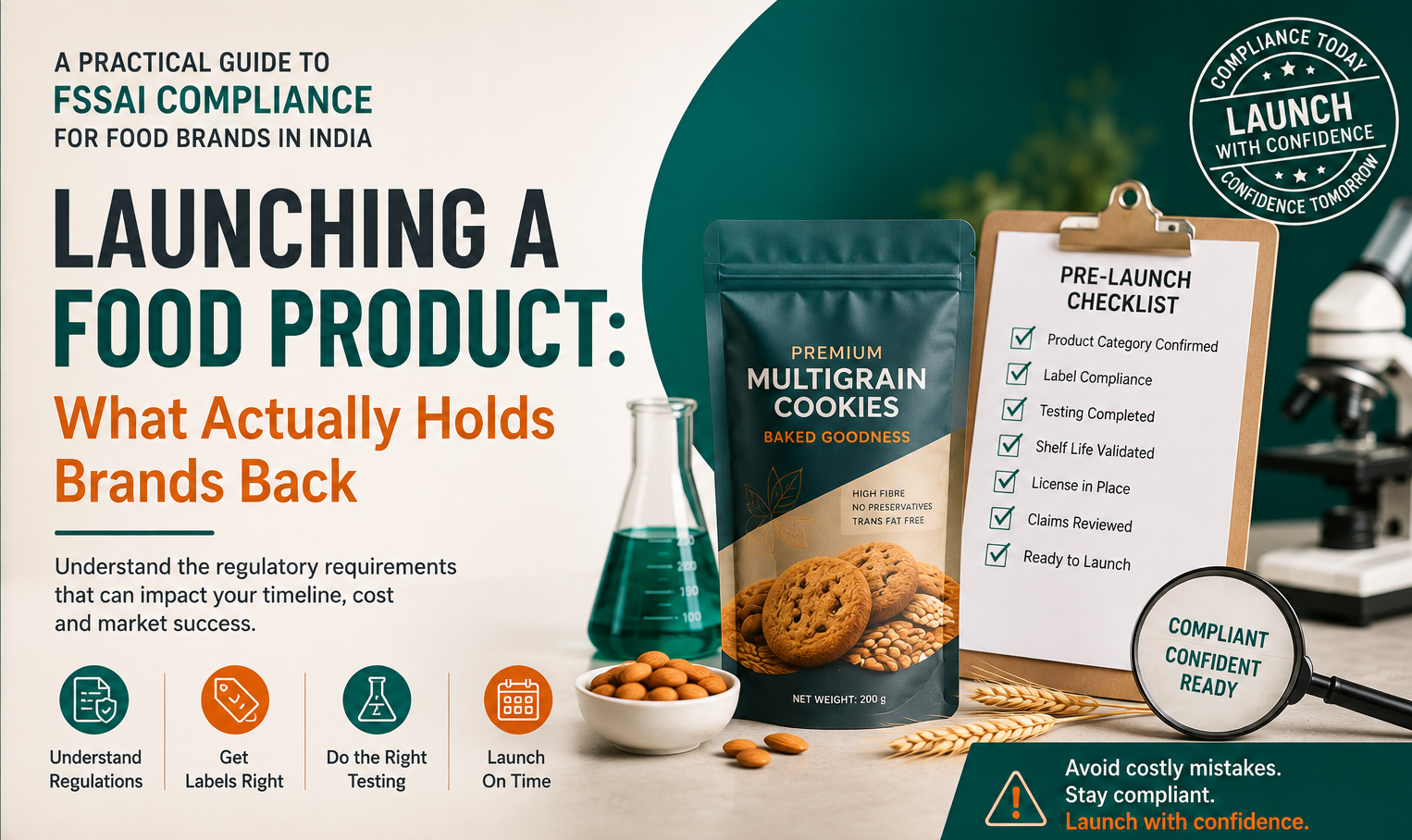
A practical guide to product categorisation, labelling, testing and shelf-life considerations for food brands launching in India.
You've spent months developing your product. You've tested formulations, run consumer focus groups, and secured interest from potential retail partners. Everything points to launch. But then you hit the regulatory requirements, and suddenly things get more complicated than you expected.
This is where most food brands encounter delays. Not because they're ignoring compliance. They're not. But because they don't fully understand which regulations apply to their specific product, and they discover this gap when it's already costly to fix.
UNDERSTANDING YOUR PRODUCT CATEGORY
Getting this wrong creates significant compliance issues. Most brands either over-comply by running unnecessary tests and incurring unexpected costs, or under-comply by missing critical requirements. The solution is to confirm your product category with FSSAI or a regulatory expert before finalizing anything else.
Getting Your Food Label Right
Your product label must include specific information in a specific format. Here's what's required:
- Manufacturer name and address
- FSSAI license number
- Net quantity in appropriate units
- Manufacturing and expiry dates (DD/MM/YYYY format)
- Complete ingredient list in descending order by weight
- Allergen warnings in contrasting color or bold text
- Nutrition information panel with standardized formatting
- Font sizes that meet minimum readability requirements
Most brands work with graphic designers who are unfamiliar with these regulatory requirements. The design looks professional and goes to print.
Then FSSAI rejects it during approval or the product is already on retail shelves when compliance issues are discovered.
Understanding Food Product Testing Requirements
Every food product requires baseline microbial testing before market launch. Testing must be conducted by NABL-accredited laboratories only. In-house testing from your manufacturer or supplier is not sufficient for regulatory compliance.
1. HYGIENE TEST PARAMETERS
These tests verify your product is free from harmful bacteria and pathogens.
2. SHELF LIFE TESTING
This determines how long your product remains safe under claimed storage conditions. You cannot claim "12 months shelf life" without scientific data.
Two approaches:
Accelerated stability testing stores samples at higher temperatures to speed up aging, then extrapolates results (faster, less expensive)
Real-time stability testing stores product under actual conditions and tests regularly over time (more accurate, takes longer)
During shelf life testing, the lab monitors microbial growth, sensory changes (taste, color, texture), chemical stability, and pH changes.
3. NUTRITIONAL TESTING
Validates all nutrient claims on your label. Every value on your Nutrition Facts label must match lab results.
4. PHYSICOCHEMICAL PARAMETERS
These tests verify your product's composition based on product type and claims.
Additional testing (depends on product type): • Pesticide residue analysis • Heavy metal testing (for powders and spices) • Aflatoxin testing • Allergen testing
3 Common Mistakes That Delay Food Product Launches
| Mistake | What Happens | How to Avoid |
|---|---|---|
| Finalizing label before testing | Claims don't match test data. FSSAI rejects approval. | Complete testing first. Build label from results. |
| Wrong product category | Compliance pathway changes halfway through. | Confirm category with FSSAI at the start. |
| Skipping shelf-life testing | FSSAI questions unsupported shelf-life claims. | Complete accelerated stability testing. |
A Practical Food Product Launch Timeline
Most product launch delays result from regulatory compliance decisions that were made too late or incorrectly. The solution is to begin your compliance process early.
8-10 Weeks Before Launch: • Confirm your product category • Identify all testing requirements • Connect with NABL labs • Prepare ingredient suppliers
4-6 Weeks Before Launch: • Submit FSSAI license application • Draft label based on test results • Have regulatory expert review • Finalize design before printing
2-3 Weeks Before Launch: • Send final artwork to printer • Review first print sample • Approve final print run • Confirm distribution logistics
Launch Week: • Receive packaging • Manufacture first commercial batch • Label and package products • Begin distribution
This approach ensures you launch on schedule rather than discovering compliance gaps that require expensive corrections.
Need Help With Your Food Product Launch?
Talk to our regulatory expertComments
No comments yet. Be the first to share your thoughts.
Add your thoughts
Contact usPrefer a call with our team? Use Contact us, or leave your email below if you want us to follow up on this comment.