
HACCP Fundamentals: What Every Food Business Needs to Know

Hazard Analysis and Critical Control Points (HACCP) is one of the world's most important food safety systems. The name sounds technical, but the idea is simple: identify where food could become unsafe, then control those points before the problem reaches the consumer.
Where It All Began
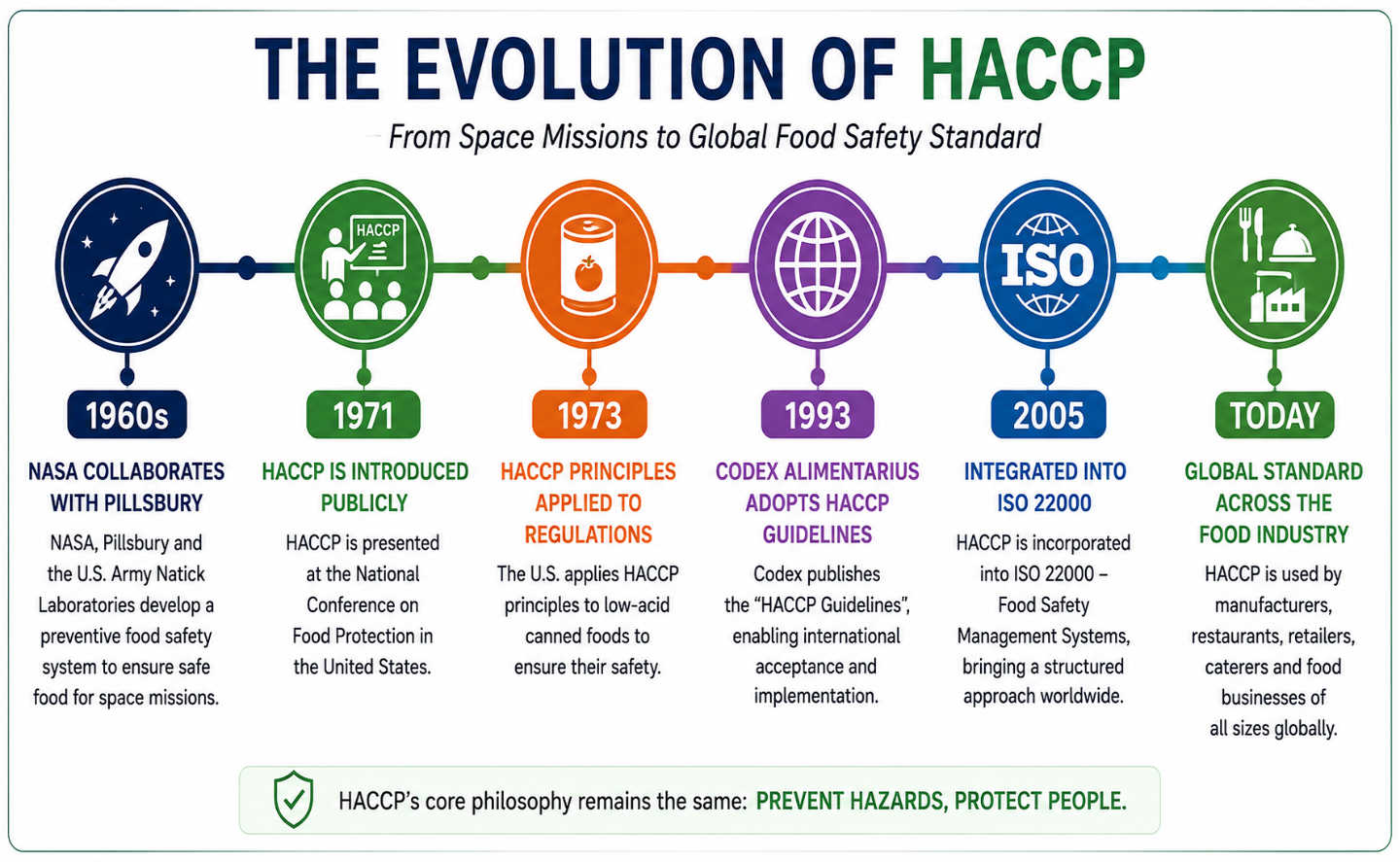
HACCP was developed in the 1960s when NASA and Pillsbury needed food that astronauts could eat with zero risk of foodborne illness. There are no hospitals in space — so the system was built to prevent hazards rather than detect them after the food was made.
Why HACCP Exists
Traditional food safety relied on inspecting finished products. But testing a handful of samples can't guarantee that every unit in a batch is safe.
HACCP asks a different question. Instead of:
"Is this product safe?"
it asks:
"Where could this product become unsafe, and how can we prevent it?"
The Four Food Safety Hazards
Every HACCP plan looks for four categories of hazards.
| Hazard | Example |
|---|---|
| Biological | Salmonella, Listeria, E. coli |
| Chemical | Cleaning chemicals, lubricants, pesticides |
| Physical | Metal fragments, glass, plastic |
| Allergens | Peanuts, milk, shellfish, soy, gluten |
The Seven HACCP Principles
Let's follow a chicken curry from receiving to serving.
1. Identify the Hazards
Ask what could realistically go wrong.
Example: Raw chicken may contain Salmonella.
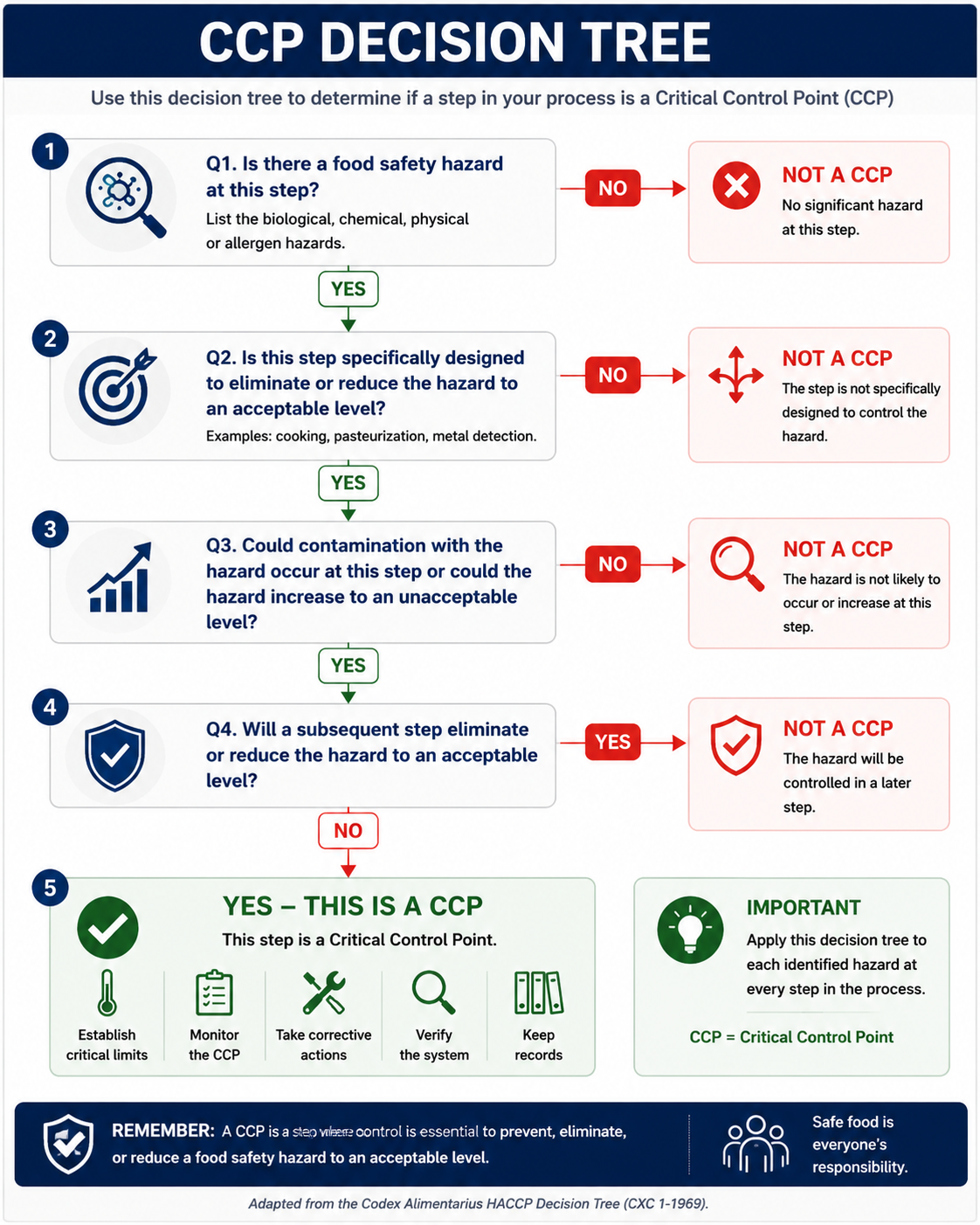
2. Identify the Critical Control Point (CCP)
Find the step where the hazard can be controlled.
Example: Cooking is the CCP because proper cooking destroys Salmonella.
3. Set a Critical Limit
A CCP needs a measurable limit.
Example: Chicken must reach 75°C at its thickest part.
4. Monitor the CCP
Measure the critical limit every time.
Example: The cook checks the chicken's temperature before serving each batch.
5. Decide Corrective Actions
Know what to do before something goes wrong.
Example: If the chicken hasn't reached 75°C, continue cooking. Never serve it "close enough."
6. Verify the System
Check that the HACCP system itself still works.
Example: Calibrate thermometers weekly using ice water (0°C).
7. Keep Records
Document monitoring results, corrective actions, and verification activities.
Without records, there's no evidence the HACCP system was followed.
HACCP Doesn't Replace Good Practices
A common misconception is that HACCP alone guarantees food safety. It doesn't.
HACCP only works when Prerequisite Programmes (PRPs) are already in place. Think of PRPs as the foundation of a house — without a strong foundation, the house won't stand.
Some essential PRPs include:
- Personal Hygiene
- Cleaning & Sanitation
- Pest Control
- Water Quality
- Equipment Maintenance
- Supplier Approval
- Waste Management
- Training & Competency
Without these basics, even the best HACCP plan will struggle to deliver safe food.
Real-World Example: Peanut Cross-Contact
A manufacturer produced both peanut-containing and peanut-free products on the same production line.
Cleaning between production runs was inadequate. Small traces of peanut remained on the equipment and contaminated the next batch labelled "peanut-free." The product was recalled after the mistake was discovered.
The incident wasn't caused by bacteria — it was caused by poor allergen control, showing that allergens deserve the same attention as any other food safety hazard.
Quick HACCP Health Check
Ask yourself:
| Question | Y | N |
|---|---|---|
| Have I identified the real hazards? | ☐ | ☐ |
| Are my CCPs scientifically justified? | ☐ | ☐ |
| Are monitoring records completed at the time of monitoring? | ☐ | ☐ |
| Are thermometers and measuring devices calibrated? | ☐ | ☐ |
| Are deviations investigated and documented? | ☐ | ☐ |
| Has the HACCP plan been reviewed after process changes? | ☐ | ☐ |
If you answered "No" to two or more questions, it's time to review your HACCP plan.
Where Do the Rules Come From?
HACCP is based on the internationally recognized Codex Alimentarius (CXC 1-1969) principles.
In India, HACCP requirements are incorporated under Schedule 4 of the Food Safety and Standards (Licensing & Registration of Food Businesses) Regulations, 2011.
ISO 22000:2018 builds on HACCP by integrating it into a complete Food Safety Management System (FSMS).
Key Takeaway
HACCP in one sentence:
Don't wait to find unsafe food — design the process so unsafe food never gets made.
Comments
No comments yet. Be the first to share your thoughts.
Add your thoughts
Contact usPrefer a call with our team? Use Contact us, or leave your email below if you want us to follow up on this comment.