
FSSAI Updates October 2026: Five Documents and What They Change
Five documents have come out of FSSAI in the past few weeks. Three of them are drafts, which means the window to object is open and will close. One is an advisory, which creates no new requirement but changes how closely you are being watched. The last is a list, and it is the one most food businesses have never opened.
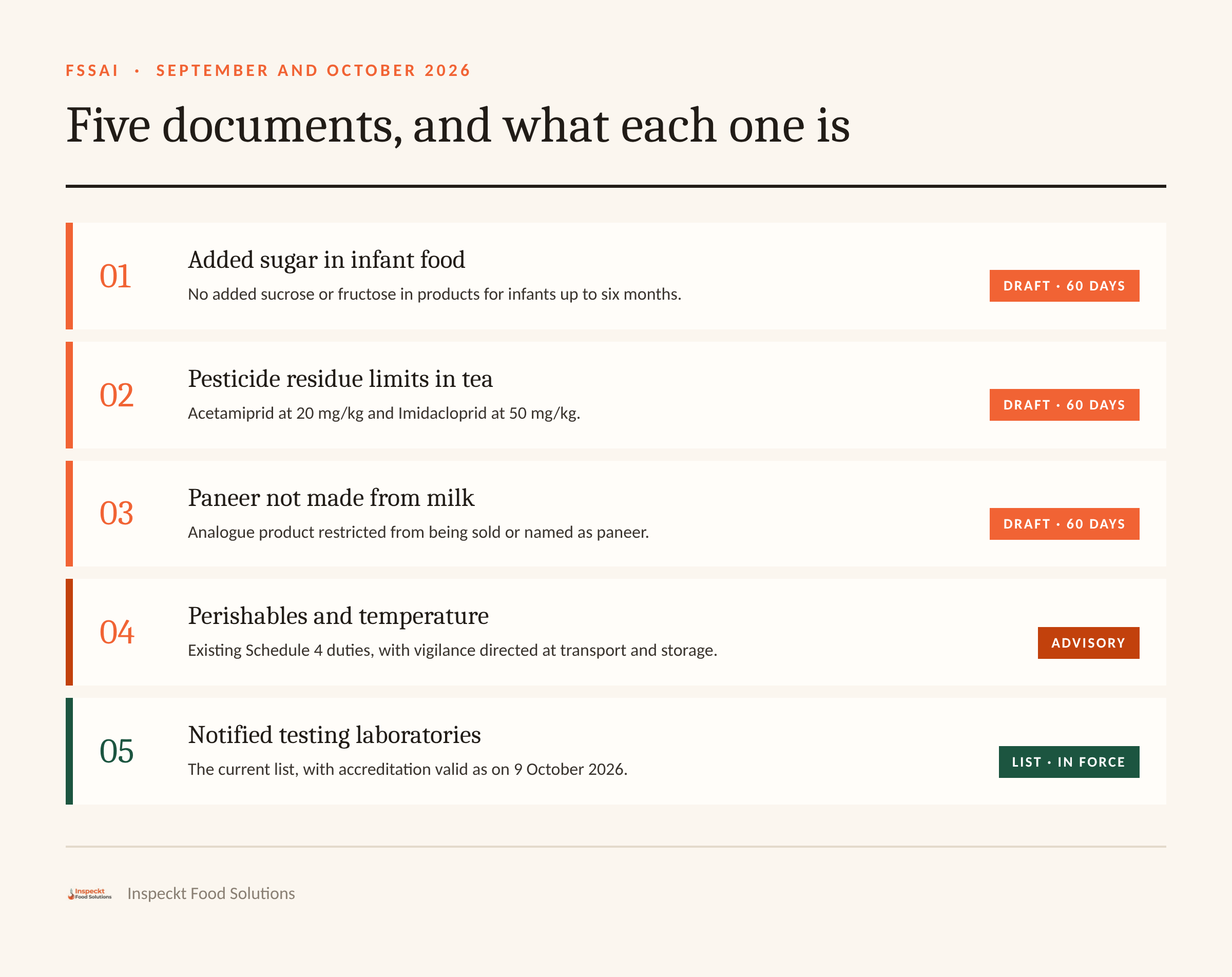
The five FSSAI documents, and what each one actually is.
1. Added sugar in infant food
Reference F. No. RCD-09002/3/2026-Regulatory-FSSAI, dated 15 October 2026.
The proposal is a single proviso added to the Foods for Infant Nutrition Regulations: sucrose and fructose shall not be added in products intended for infants up to the age of six months.
That is the entire change. One sentence. If you manufacture in that category, the question is whether your formulation relies on either, and what replacing it does to stability, texture, shelf life and the claims already printed on your pack. Reformulation is rarely a single change.
Draft. Sixty days from publication for objections, to the Chief Executive Officer or regulation@fssai.gov.in.
2. Pesticide residue limits in tea
Reference F. No. SS-T0SP02(NOTI)/1/2025-Standard-FSSAI, also dated 15 October 2026. Two entries proposed for the table in the Contaminants, Toxins and Residues Regulations.
| Compound | Food Category | Maximum residue limit (mg/kg) |
|---|---|---|
| Acetamiprid | Tea | 20 |
| Imidacloprid | Tea | 50 |
If tea is an ingredient anywhere in your range, the useful question is not whether your supplier sends you a certificate of analysis. Most of them do. It is which pesticides that certificate actually covers. A test for ten compounds tells you nothing about the eleventh.
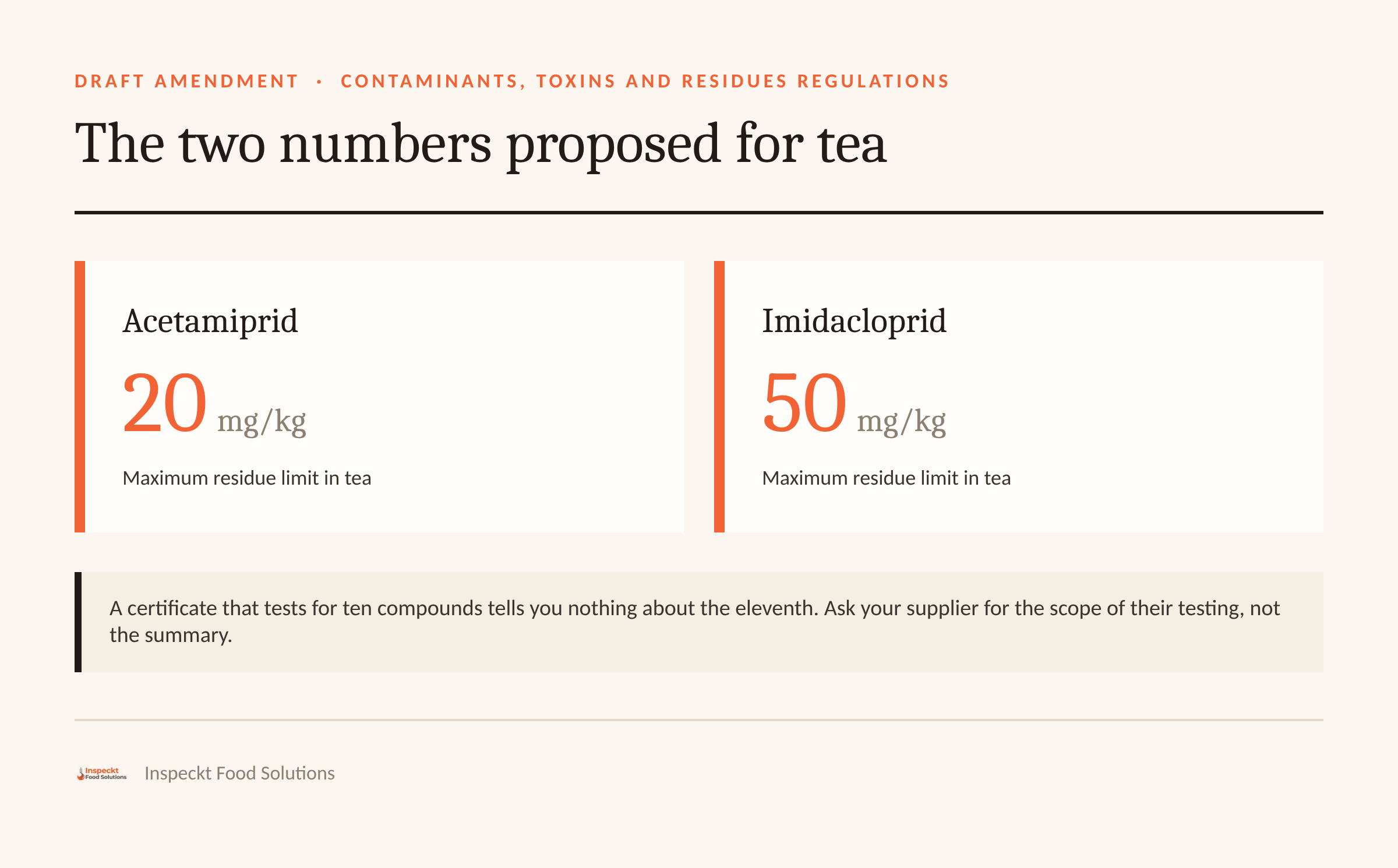
The two maximum residue limits proposed for tea.
Also a draft, also sixty days.
3. Paneer that is not made from milk
Reference F. No. RCD-15001/1/2024-Regulatory-FSSAI, gazetted 23 September 2026.
A draft amendment to the Prohibition and Restrictions on Sales Regulations adds one clause to the list of restricted items: paneer made of constituents not derived from milk.
The stated purpose is to stop consumers being misled about the nature and composition of what they are buying. Products already licensed or registered under the analogue dairy category would have to drop the word paneer from naming, labelling and marketing.
If you make, pack or sell an analogue product, this is not a labelling tweak. It is the name coming off the pack, and everything printed, listed and advertised under that name going with it.
Draft, sixty days.
4. Perishables and controlled temperature
Reference F. No. RCD-15001/11/2021-Regulatory-FSSAI, dated 15 October 2026. This one is an advisory rather than a regulation, and the distinction matters.
It creates no new requirement. Schedule 4 of the Licensing and Registration Regulations already requires prescribed temperature to be maintained across the whole chain, from sourcing through chilling, transport, storage and distribution to the end consumer. Temperature abuse is already non compliance.
What the advisory does is direct attention. It names khoa, paneer, meat and fish. It tells Commissioners of Food Safety in every state and union territory, Indian Railways and FSSAI's regional directors to keep strict vigilance during inspections and transportation checks. It singles out gunny bags and other non food grade coverings. It mentions seizure and destruction where there is non compliance.
Nothing about the standard has changed. The odds of somebody checking have.
5. The list of notified testing laboratories
Reference QA-12012/1/2021-RARD-FSSAI, issued by the Quality Assurance Division. Not a rule. It is the current list of FSSAI notified, NABL accredited food testing laboratories, with accreditation validity as on 9 October 2026, across four regions. The list runs to 256 laboratories.
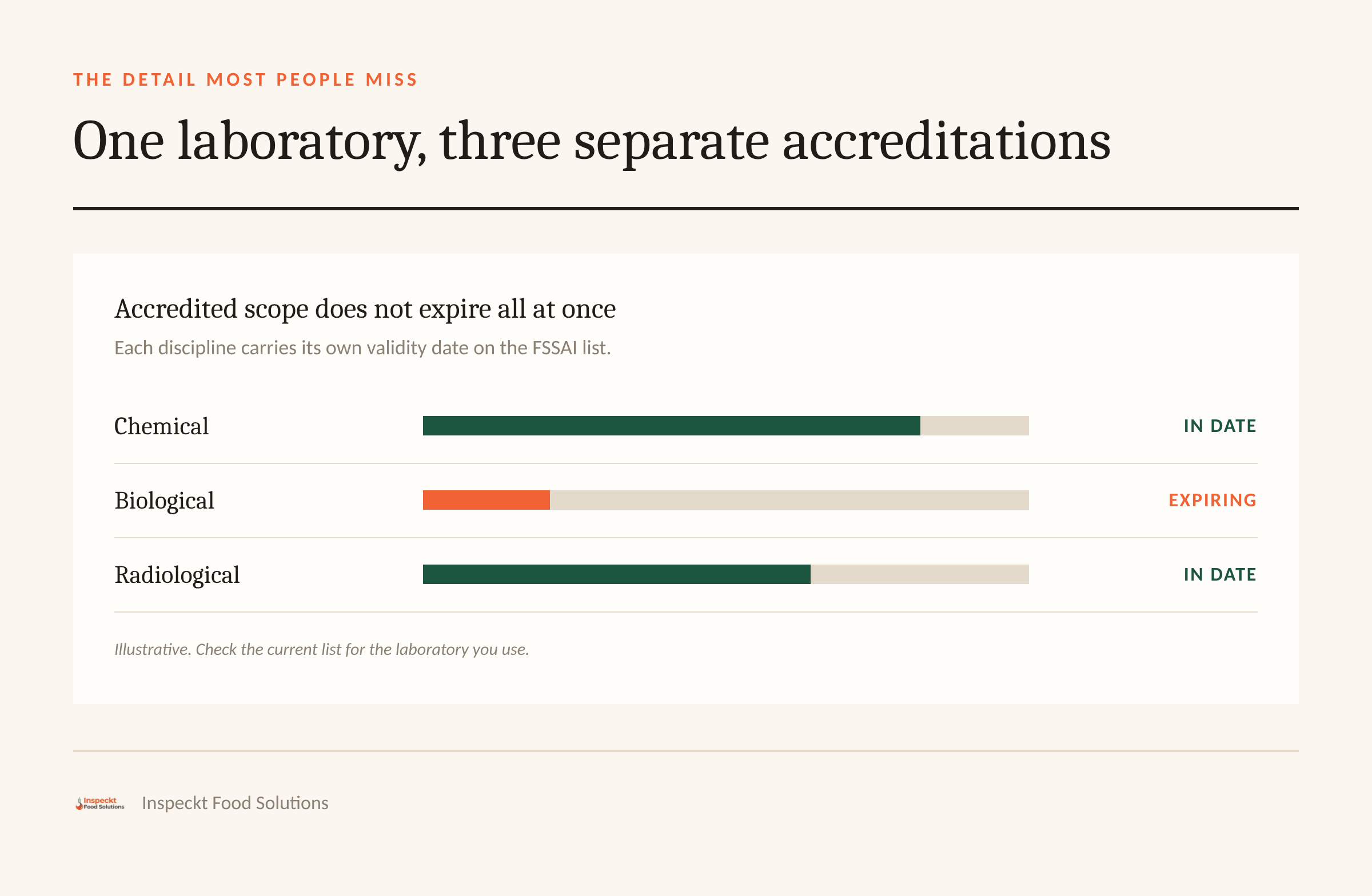
Here is the detail most people miss. Each laboratory carries separate validity for chemical, biological and radiological testing, and those dates do not expire together. A laboratory can be entirely valid for chemical analysis and outside its accredited scope for the microbiological test you sent it last week.
Accreditation is granted by discipline, and the dates do not run together.
It matters because these are the laboratories whose results carry weight for samples analysed under Section 47 of the Food Safety and Standards Act. A result from one that is not notified, or not accredited for that specific test, may not do the job you needed it to do.
The part that gets missed
Three of these five are drafts. That word tends to get read as not yet my problem, and the file gets closed.
It is closer to the opposite. A draft is the only point at which a rule is still moveable. Once it is final your options are to comply or to argue after the fact, and both of those cost more than a letter sent inside the comment window.
Industry associations use that window. The individual manufacturers who will actually have to reformulate, or rename a product, mostly do not. If a proposal would be genuinely difficult for your product, saying so now, with your reasoning, costs you an afternoon.
Worth doing this week
Infant products: check whether sucrose or fructose is in the formulation.
Tea: ask your supplier for the scope of their pesticide testing, not the summary.
Analogue dairy: work out what a name change would cost across packaging, listings and advertising, before the draft becomes final.
Perishables: look at how your khoa, paneer, meat or fish actually travels, including the vehicle and the packaging, rather than the policy that says how it should.
Laboratories: check yours is on the current list, for the tests you actually send it.
Put all three comment deadlines in the calendar.
Before you act on any of this
Drafts get revised, lists get reissued, and advisories are followed by more advisories. Check the current text before you make a decision that costs money. If any of these has left you uncertain, that is usually a short conversation rather than a project.
Sources
F. No. RCD-09002/3/2026-Regulatory-FSSAI, draft Food Safety and Standards (Foods for Infant Nutrition) Amendment Regulations, 2026. FSSAI, 15 October 2026. Gazette of India, 16 October 2026.
F. No. SS-T0SP02(NOTI)/1/2025-Standard-FSSAI, draft amendment to the Food Safety and Standards (Contaminants, Toxins and Residues) Regulations, 2011. FSSAI, 15 October 2026. Gazette of India, 16 October 2026.
F. No. RCD-15001/1/2024-Regulatory-FSSAI, draft Food Safety and Standards (Prohibition and Restrictions on Sales) Amendment Regulations, 2026. FSSAI, 22 September 2026. Gazette of India, 23 September 2026.
F. No. RCD-15001/11/2021-Regulatory-FSSAI, Advisory on Handling, Storage and Transportation of Perishable Food Commodities under Controlled Temperature Conditions. Regulatory Compliance Division, FSSAI, 15 October 2026.
QA-12012/1/2021-RARD-FSSAI, Validity of FSSAI recognised Food Testing Laboratories. Quality Assurance Division, FSSAI. Accreditation validity as on 9 October 2026.

Comments
No comments yet. Be the first to share your thoughts.
Add your thoughts
Contact usPrefer a call with our team? Use Contact us, or leave your email below if you want us to follow up on this comment.