
You Saw an Ingredient Abroad and Want to Launch It in India? Here's What FSSAI Will Ask You
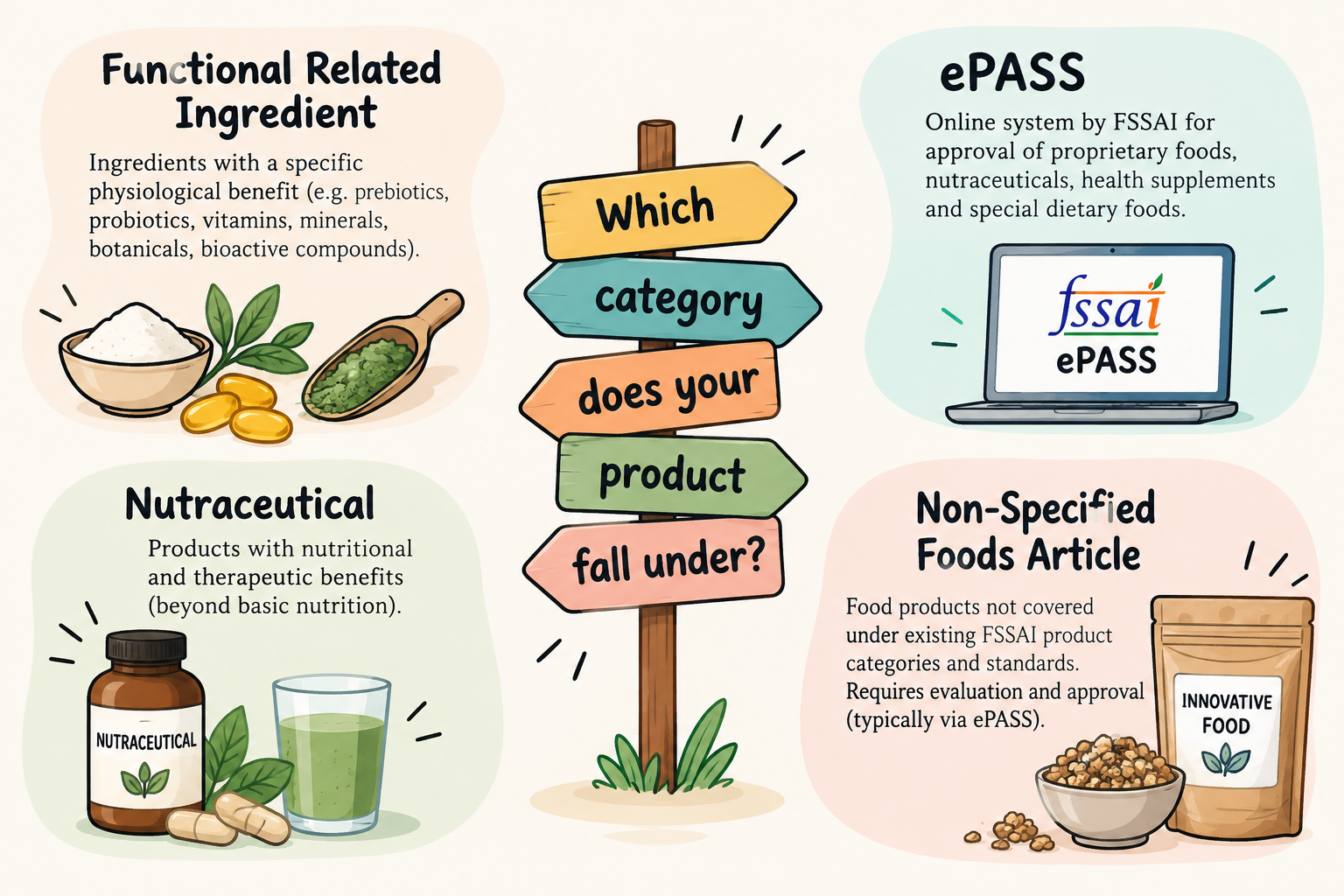
FSSAI Compliance · Functional Ingredients
By Diptasree Chaudhuri, Inspeckt Food Solutions · September 2026
You saw it on a shelf in Singapore, or in a friend's supplement stack from the US, or in a founder's Instagram launch. Or it's more personal: you had trouble sleeping, or your gut, or your energy, found an ingredient that helped, and thought, why isn't this made properly in India?
I hear this from founders every week, and it's a good instinct. But the ingredient's success somewhere else, or on you, doesn't tell you if you can make it and sell it here. I'd rather you hear that from me now than from a rejection letter after you've paid a manufacturer. This is how I'd walk you through it: where the ingredient stands with FSSAI, and if it needs approval, how that process actually runs.
Start with the ingredient's status
The ingredient being sold abroad in your protein shake or pre work drink , or in an supplement which helped you in your health journey, doesn't tell you whether you can use it in your product which will be launched in india .
What matters is where it sits in FSSAI's framework, and there are four places it can be.
| Listed for your use- Named in the regulations for the category, plant part or use you want | → | Use it within the listed conditions No approval for the ingredient itself. Your claims still need their own check |
| Listed, but not for your use- A plant part not in the schedule, or a different category or level | → | Outside the listed conditions Apply to FSSAI. For plant parts not listed, FSSAI's nutraceutical FAQ says the FBO has to apply for approval |
| Long history of use, not in the regulations- Eaten for years in India or abroad, but never included | → | Still needs approval The FAQ is explicit: history of safe use doesn't remove the requirement |
| Novel- No history of human consumption, a new source, or a technology that significantly changes composition | → | Prior approval before licence Plus additional toxicology data |
Where an ingredient can sit. Based on FSSAI's nutraceutical regulations FAQ and the Non-Specified Food Regulations, 2017.
Five ingredients, different answers
Your ingredient may not be on this list, but one of these will probably look like it. Each sits in a different place and teaches something different.
Ashwagandha
LISTED, WITH CONDITIONS
What FSSAI says
On 21 April 2026 FSSAI advised that only the roots and root extracts of Withania somnifera are permitted, under Schedule IV of the 2016 nutraceutical regulations. Leaves, in crude, extract or any other form, are not. The Schedule IV entry itself lists the root at 3 to 6 g as powder and the extract at 0.5 to 1 g.
What it means for you
Being on the list doesn't mean any part in any form. A supplier's leaf-based extract is outside the listing even though the plant is on it. Ask for the plant part on the certificate of analysis.
FSSAI Nutraceutical Regulations compendium (2021), Schedule IV entry 432; reports of the April 2026 advisory (ANI, Food Spectrum)
Probiotic strains
LISTED STRAINS ONLY
What FSSAI says
Schedule VII lists 30 permitted organisms, under current taxonomy names: Lacticaseibacillus rhamnosus, Lactiplantibacillus plantarum, Limosilactobacillus reuteri, Bifidobacterium species, Streptococcus thermophilus, Saccharomyces boulardii, Bacillus coagulans and others. They may be used singly or in combination, must be declared on the label with full information, and must be non-GMO. The Authority can add strains after scientific evaluation. The FAQ sets 10⁸ CFU or more per daily serving.
What it means for you
Check your supplier's species name against the current Schedule VII wording, since older names like Lactobacillus rhamnosus have been renamed. A culture that isn't on the list, like a traditional kombucha consortium, can't be assumed to support a probiotic claim.
FSSAI compendium (2021), Schedule VII; nutraceutical FAQ Q56
NMN
NOT LISTED, NOT APPROVED
What FSSAI says
On 24 July 2026 FSSAI sent notices to companies and e-commerce platforms calling NMN an unapproved ingredient and directing products to be delisted, as reported by NutraIngredients. It isn't in the 2016 regulations, and it isn't on FSSAI's approved Non-Specified Food list. Reportedly, two applications are in process and six have been rejected.
What it means for you
If your formula depends on NMN, approval is the only legal route, and the record shows how hard that route is. Being sold on a marketplace tells you nothing about status.
NutraIngredients (3 and 17 Aug 2026); FSSAI approved list (2 May 2025)
L-theanine
LISTED NUTRACEUTICAL INGREDIENT
What FSSAI says
Schedule VI, Part A, entry 24 lists L-theanine (common name Chai suksham satva) at 50 to 200 mg per day, maximum. The caffeinated beverage standard, from what I could read, provides for taurine, inositol and vitamins within limits, and doesn't mention it.
What it means for you
Listed means a permitted daily range as a nutraceutical ingredient. It doesn't mean it can go into any category.
In a caffeinated drink you'd be adding a nutraceutical ingredient to a beverage standard that doesn't provide for it, so check the category and the source first.
Statuses reflect the sources named on each card. Regulations and advisories change, so confirm on FSSAI's site before you commit to an ingredient.
How short is the approved list?
| 332 | entries on FSSAI's approved Non-Specified Food list, as on 2 May 2025 |
| 1 | monk fruit entry: juice or concentrate, approved in 2019 to a single applicant |
Source: FSSAI, list of product and ingredient applications approved under the Non-Specified Food Regulations, as on 2 May 2025. Later approvals may exist.
What "approval" actually means
If your ingredient isn't covered, the route is the Food Safety and Standards (Approval for Non-Specified Food and Food Ingredients) Regulations, 2017. The starting rule is blunt: no one may manufacture or import a non-specified food or food ingredient without the prior approval of the Food Authority.
Notice that the rule applies to manufacturing as well as selling. So a trial batch for commercial purposes doesn't sit outside it.
Does an approved ingredient mean your product is FSSAI approved?
No, and this is the misunderstanding I see most. Founders hear "the ingredient is listed" or "it got Non-Specified Food approval" and read it as "my product is approved." Those are different things, and they answer different questions.
| What you have | What it tells you | What it doesn't tell you |
|---|---|---|
| Ingredient is listed in a schedule | You can use it within the listed conditions: part, form, level, category | That your product, claims or label are compliant |
| Non-Specified Food approval | FSSAI assessed that specific ingredient or product, for that applicant | That your formulation, or someone else's use of the same ingredient, is cleared. The approved list reads as individual decisions |
| FSSAI licence or registration | Your business is licensed to operate in that activity | That each product you make is approved |
Based on the Non-Specified Food Regulations, 2017, the nutraceutical regulations and the approved list of 2 May 2025.
Your product still has to meet its own category's standard, any dose limits, its labelling and its claims. Even after an approval comes through, any health claim is checked against its own requirements.
The process, step by step
Here's how the Regulations lay it out for you. The teal steps are yours. The terracotta ones are FSSAI's.
| 1 | Classify the ingredient Novel food, new ingredient, new source, new technology, or an existing ingredient used outside its conditions. This decides what evidence you owe. |
| 2 | Build the dossier and file Application in the prescribed form, with the documents and the fee. The fee is not refunded under any circumstances, so file when the dossier is complete. |
| 3 | Scrutiny FSSAI checks the application and tells you about any deficiencies. Within 45 days of receipt |
| 4 | You respond Deficiencies and clarifications have to be answered. The period can be extended, but only for documented reasons. 30 days from the letter |
| 5 | Expert review The Authority may appoint an expert committee or panel to examine the application. This is where the safety assessment happens. |
| 6 | Decision Approval or rejection, on the basis of the safety assessment. |
| 7 | After approval You provide post-market surveillance data. Approval can also be suspended or revoked, with reasons recorded in writing. Within 1 year of placing the product on the market |
Non-Specified Food Regulations, 2017, Regulation 4. Applications now go through ePAAS. Check the portal's current forms and fee before filing.
If you're rejected
There's a defined appeal route. You can appeal to the CEO within 30 days of the rejection letter, and the CEO decides within 30 days. If that goes against you, you can seek a review by the Chairperson within 30 days of the appellate order, and that too is to be disposed of within 30 days. Miss the 30-day window and you're effectively starting again.
| The clock | Period | Who acts |
|---|---|---|
| Scrutiny and deficiency letter | 45 days | FSSAI |
| Response to deficiency letter | 30 days | FBO |
| Appeal to the CEO after rejection | 30 days | FBO |
| CEO decides the appeal | 30 days | FSSAI |
| Review by the Chairperson | 30 days | FBO, then FSSAI |
| Post-market surveillance data | 1 year | FBO |
Source: Food Safety and Standards (Approval for Non-Specified Food and Food Ingredients) Regulations, 2017, as in FSSAI's October 2022 compendium.
What goes in the dossier
This is where most applications stall, and it's the part you control. The application form asks for a certificate of analysis from an accredited laboratory, the manufacturing process flowsheet, the regulatory status of the ingredient in other countries, safety and toxicity documentation, evidence for any health benefit claim, and your proposed label. For novel foods, there is an additional set of toxicology studies.
Two points from working with these:
1.First, other country where the ingredient is used ,the said country's FDA approval is evidence, not a substitute. The form asks for it because it helps the assessment, but the assessment is FSSAI's.
2. Second, if you plan to claim a health benefit, that evidence goes in at the start. It's much harder to bolt on later.
Where ePAAS fits
ePAAS is FSSAI's electronic Product and Claim Approval Application System. An office order dated 6 May 2026 made it the single window for prior approval and risk assessment applications, effective 1 June 2026. So if your ingredient needs approval, that's where you file.
What ePAAS doesn't do is tell you which route you're on. That work has to be done before you log in: what the ingredient is, whether it's listed, whether it's novel, what claim you'll make. The portal can't fix a wrong classification or a thin dossier.
You're really deciding sequence. Founders who ask the ingredient question first have three options: use something already listed, choose a different ingredient, or start the approval early. Founders who ask it last usually have one, which is to wait.
Inspeckt Food Solutions helps Indian food and wellness brands work out where an ingredient sits, build the dossier and take Non-Specified Food applications through. If you're looking at a new functional ingredient and want the route mapped before the formulation is frozen, get in touch.
Comments
No comments yet. Be the first to share your thoughts.
Add your thoughts
Contact usPrefer a call with our team? Use Contact us, or leave your email below if you want us to follow up on this comment.