
Festive Season Food Safety for Sweet Businesses in India
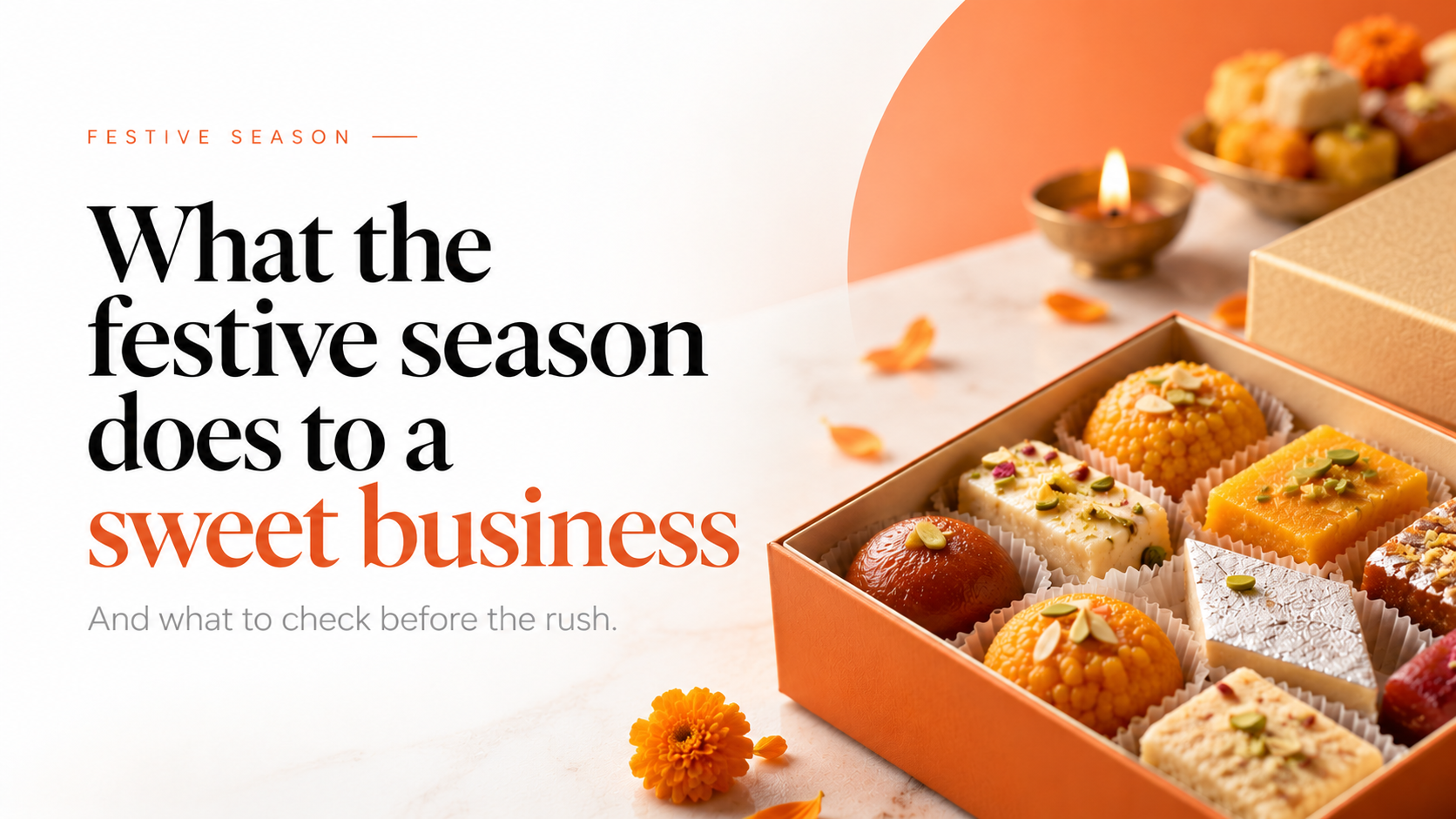
What Diwali does to a sweet business, and what to check before the rush
For most of the year a sweet shop runs on rhythm. You know roughly what Tuesday looks like, you make roughly what you made last Tuesday, and most of what you make is eaten the same day it leaves the counter.
Then Navratri starts and every one of those assumptions goes.
Volume multiplies. Boxes and combos appear that did not exist in August. You take khoa from a supplier you have never bought from, because the regular one cannot meet the quantity at four days' notice. Half the people on the floor were hired three weeks ago. And the sweet that leaves your counter is no longer eaten that evening.
The sweet you sell today is eaten on Thursday, in somebody else's house
This is the part of the festive season that does the real damage, and it has nothing to do with how clean your kitchen is.
For most of the year, a customer buys 250 grams of barfi and eats it that night. In Diwali week, the same barfi goes into a box, the box goes into a car, the car sits in the sun outside three more houses, and the box is opened on day four by somebody who was not told when it was made. Some of it gets passed on again unopened.
Your shelf life was almost certainly worked out for the first scenario. Festive season runs the second one, at volume, in October weather.
A Diwali sweet is not a same day product. It is a travelling product, and almost nobody prices its shelf life that way.
This matters most for anything with khoa, chhena or fresh cream, and for anything fried and then stored. Those are precisely the items that sell hardest in the festive fortnight.
A gift box is only as safe as its shortest lived item
Gift boxes are where this gets expensive, because a box is not one product. It is six products with six different shelf lives sitting in one container at one temperature.
Put a kaju katli, a milk based peda and something fried into the same box and the box behaves like the peda. If anyone in your business is thinking about the life of that box, it has to be the shortest item that sets it, not the average and definitely not the longest.
The same logic applies to how the box is stored on your own shelf while it waits to be sold. A box assembled on Monday for a Friday pickup has already spent four days of its life before the customer has touched it.
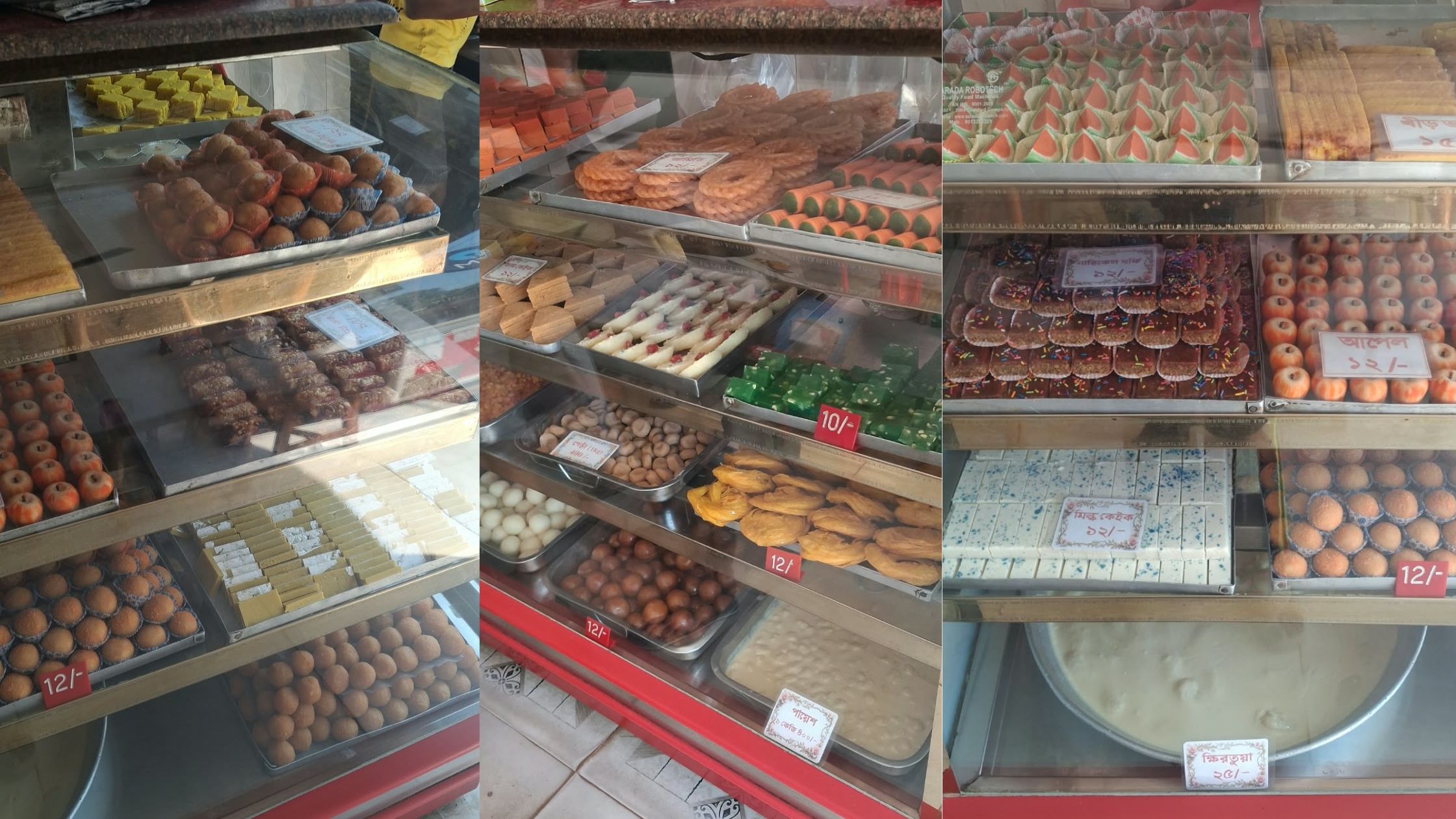
The colour Problem
Bright sells in festive season. Walk past any counter this fortnight and the trays that catch your eye are the coloured ones.
Colour is also the quickest way to get a sample picked up. Only a short list of synthetic colours is allowed in food in India, and even those have limits on how much you can use. Anything off that list should not be in a sweet at all. Rhodamine B, the one behind a lot of strong pinks, is not a permitted food colour in any quantity.
Karnataka has gone further than most states and banned artificial colours outright in several dishes, after testing kept finding them. It has not solved it. A report this year found banned colours still turning up in outlets across Bengaluru, sweets among them.
The risk for most sweet businesses is not that somebody chose a banned dye on purpose. It is that nobody chose anything. The colour came in a packet from a supplier, or it came already mixed into a sweet bought in from a halwai to sell on, and no one asked what was in it.
So ask. Get the name of the colour and get it in writing. If your supplier cannot tell you what is in the tin, you already know enough.
So should you be putting a date on it
The honest answer is that the rules on this have moved, and where you are matters more than what you read in a national headline.
Displaying a best before date on loose sweets was made mandatory from October 2020. That requirement was withdrawn on 7 November 2023, days before Diwali that year, because the direction had been built on a labelling regulation that no longer existed. FSSAI said date marking on unpackaged food needed more deliberation and left it there. So centrally it is voluntary at the moment.
States have not all left it there. Uttar Pradesh has made a use by date mandatory on loose and open counter sweets with effect from 15 October 2026, with the seller choosing the date based on the product, its ingredients and the weather, and carrying responsibility for the sweet being fine through that period.
Which means the only answer that helps you is your own state's answer, not the national one.
Forget the rule for a minute. A date is useful because it makes someone sit down and decide how long the sweet is actually good for, in this heat, inside that box. Most festive trouble starts because nobody ever made that call.
And if you do print a date, know how you got to it. A date you can explain protects you. A date you cannot explain does the opposite.
Where the rush actually breaks things
Across a festive fortnight, the same handful of things go wrong, and none of them are exotic.
- A supplier swapped at short notice, usually for khoa or oil, with nothing on file about them beyond an invoice.
- A batch scaled well past the size the process was ever worked out for, so mixing, cooling and storage all behave differently.
- Gift packs and combos that sit outside the scope the licence was actually granted for, because nobody checked when the format was invented in September.
- A label reprinted for a new box weight and never looked at again.
- Seasonal staff on a line where the controls live in somebody's head rather than on paper, and that somebody is working sixteen hour days.
And this year there are more people looking
On 29 September 2026 FSSAI asked the Commissioners of every state and union territory to run a special drive through Navratri and Diwali, with inspections and sampling focused on busy markets and known hot spots. Sweets are named in it, along with milk products including ghee, khoa and paneer.
It does not create a single new requirement. The standards next week are the ones that applied in August. What has changed is the chance that somebody turns up while your kitchen is at four times its normal output.
Worth an afternoon this week
- Take your three fastest moving festive items and work out their real life in a closed box at room temperature, not on a shelf in your shop.
- For anything coloured, find out which colour is in it and whether it is permitted. That applies to sweets you buy in to resell as much as the ones you make.
- For every gift box, identify the shortest lived item in it and let that set how long the box is good for.
- For any raw material from a new supplier, get something on file beyond the invoice, and check it against what you agreed to buy rather than the number printed on the certificate.
- Confirm your licence covers every festive format you are selling, gift packs and combos included.
- Decide who speaks if an officer draws a sample on a Saturday, and tell that person it is them.
After the festival
One last thing that gets forgotten every year. Unsold festive stock does not become ordinary stock on the 2nd of November. It is older than it looks, it has been handled more than usual, and it was made in your most chaotic fortnight. Decide what happens to it before you are standing in front of it.
Comments
No comments yet. Be the first to share your thoughts.
Add your thoughts
Contact usPrefer a call with our team? Use Contact us, or leave your email below if you want us to follow up on this comment.