
Allergen Mistakes on Indian food industry and How to Fix Them
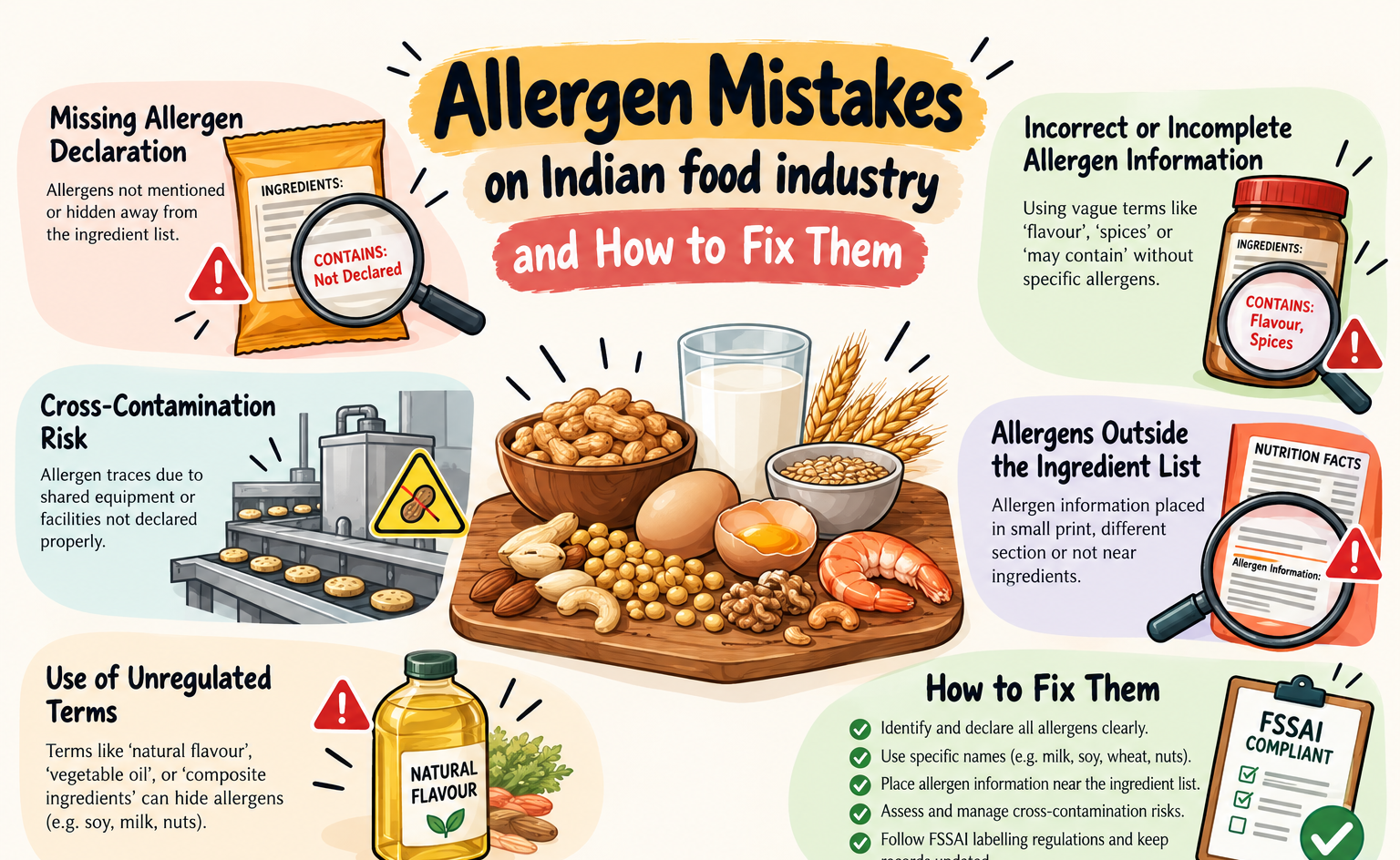
Allergens on Indian food labels: What auditors keep finding
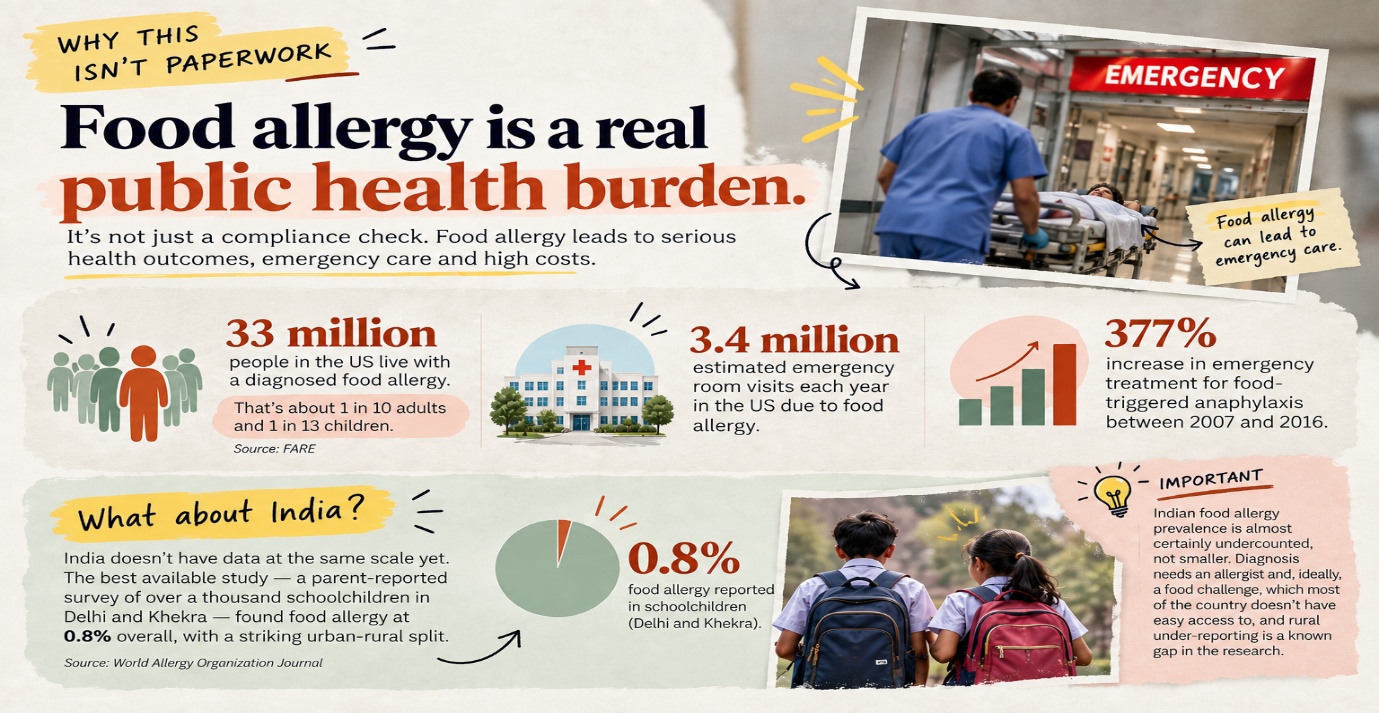
An allergen declaration is the written statement made by a food business indicating whether or not a product contains substances capable of causing a serious immune response. In India such allergen labelling is regulated by the Food Safety and Standards (Labelling and Display) Regulations of 2020.
Failure mostly takes place below the ingredient list, not on it.
A contract manufacturer can alter the fat, flavour or premix without updating the label; in a restaurant, a QSR or a catering business a chef may change a sauce or supplier even if the menu or the front-of-house allergen information stays the same. In each of these situations the customer is being given information about a product which no longer exists.
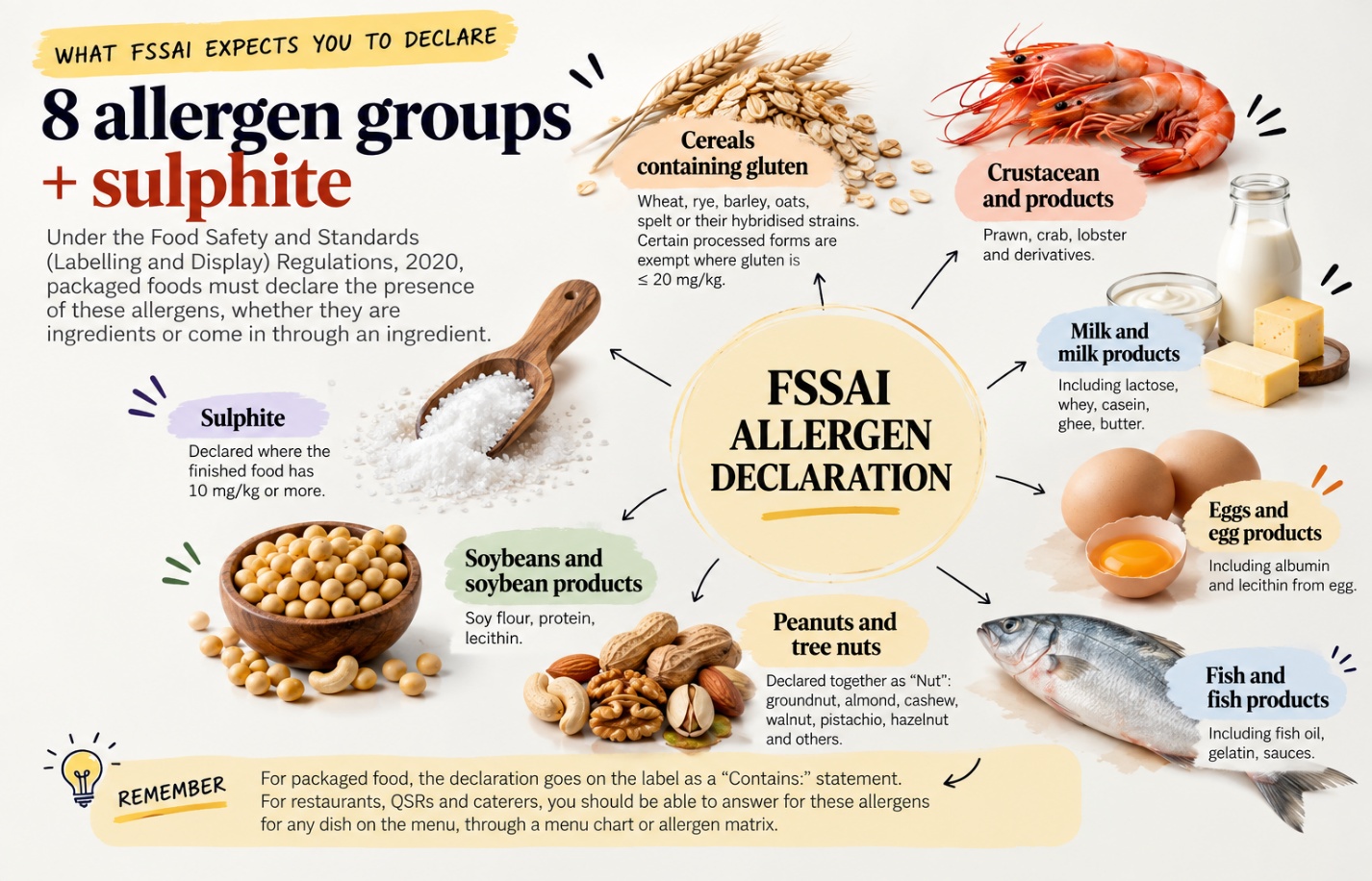
What FSSAI expects you to declare
For packaged food, FSSAI requires declaration of these allergen categories when present as ingredients or through ingredients:
- Cereals containing gluten, including wheat, rye, barley, oats, spelt and hybrids
- Crustacea
- Milk and milk products
- Eggs and egg products
- Fish and fish products
- Peanuts and tree nuts, including almonds, walnuts, pistachios and cashews
- Soybeans and their products
- Sulphite at 10 mg/kg or more
With packaged products, information about allergens is given via a "Contains:" statement, and restaurants, quick-service restaurants and caterers should also provide similar written information using an allergen chart, menu or information available at the counter, this being supported by their trained staff.
The FSSAI's requirement for eating establishments to give allergen information in writing has been in force since 1 January 2022.
Where declarations go wrong
The problems that recur are generally concealed in the various ingredients and due to changes in suppliers.
The following ingredients – 'compound chocolate', 'seasoning', 'spice mix' and 'natural flavour' – might contain milk, soy or wheat as a result of the carriers or other components.
Things like casein or soy lecithin may cause allergens which would be overlooked in a simple check of the ingredient names.
Sulphites: Certain dried fruits, as well as some vinegars and wine-based ingredients, can cause a product to exceed the 10 mg/kg limit.
Formulation drift happens when a label gets approved once. No one checks it again after the recipe, supplier, or ingredient changes.
There's a contradiction in the documents: the pack states that it contains milk, the specification sheet says it is milk-free, and the website describes the product as vegan. So at least one of the documents is incorrect.
The way to deal with this is to create an allergen matrix for each SKU or menu item. This matrix must include all the ingredients, the suppliers and the allergen status, and it should be connected to the change control system. Whenever there is a change made by a supplier or to a recipe, this should automatically lead to a review of the allergen information and the label.
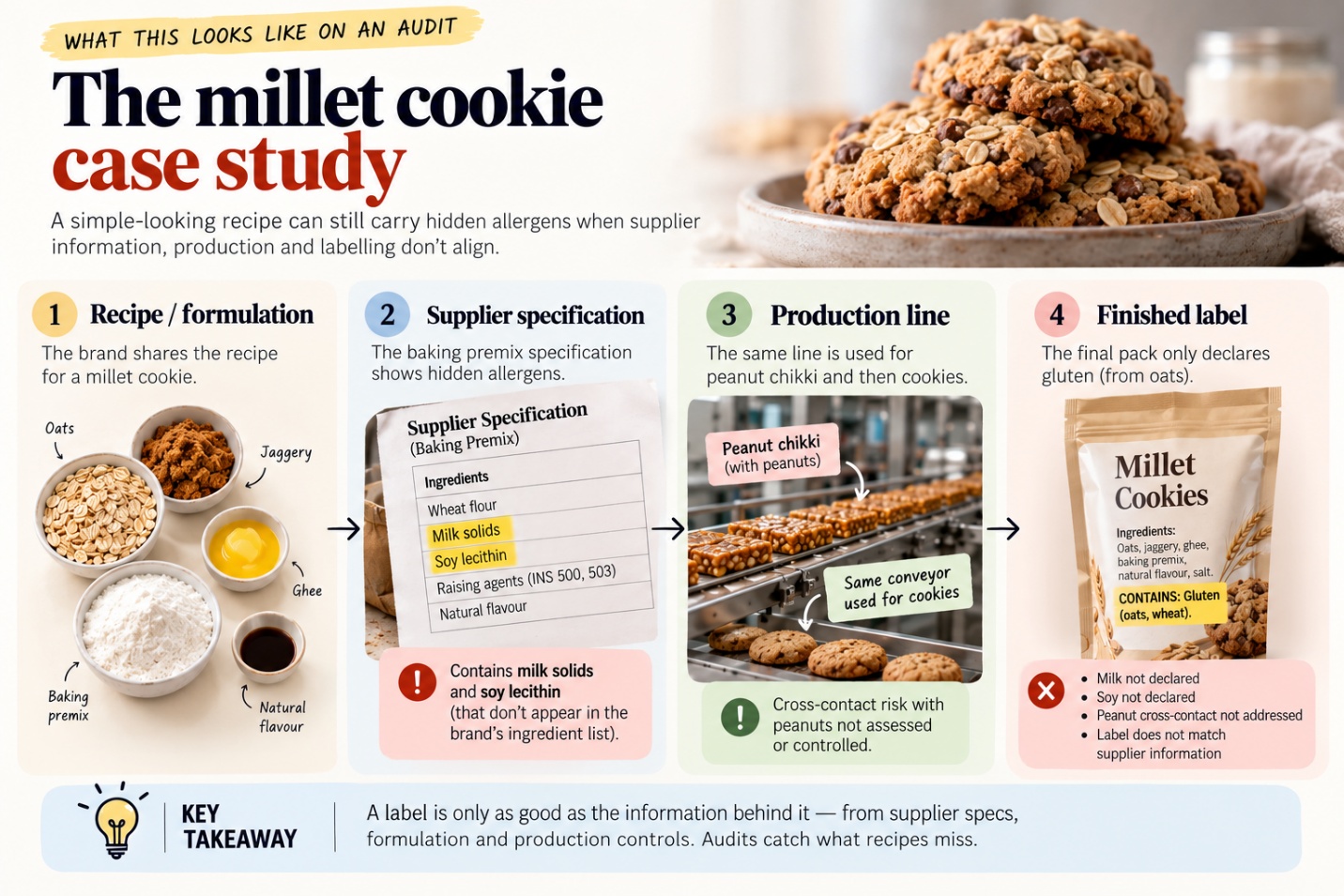
Cross-contact and “may contain”
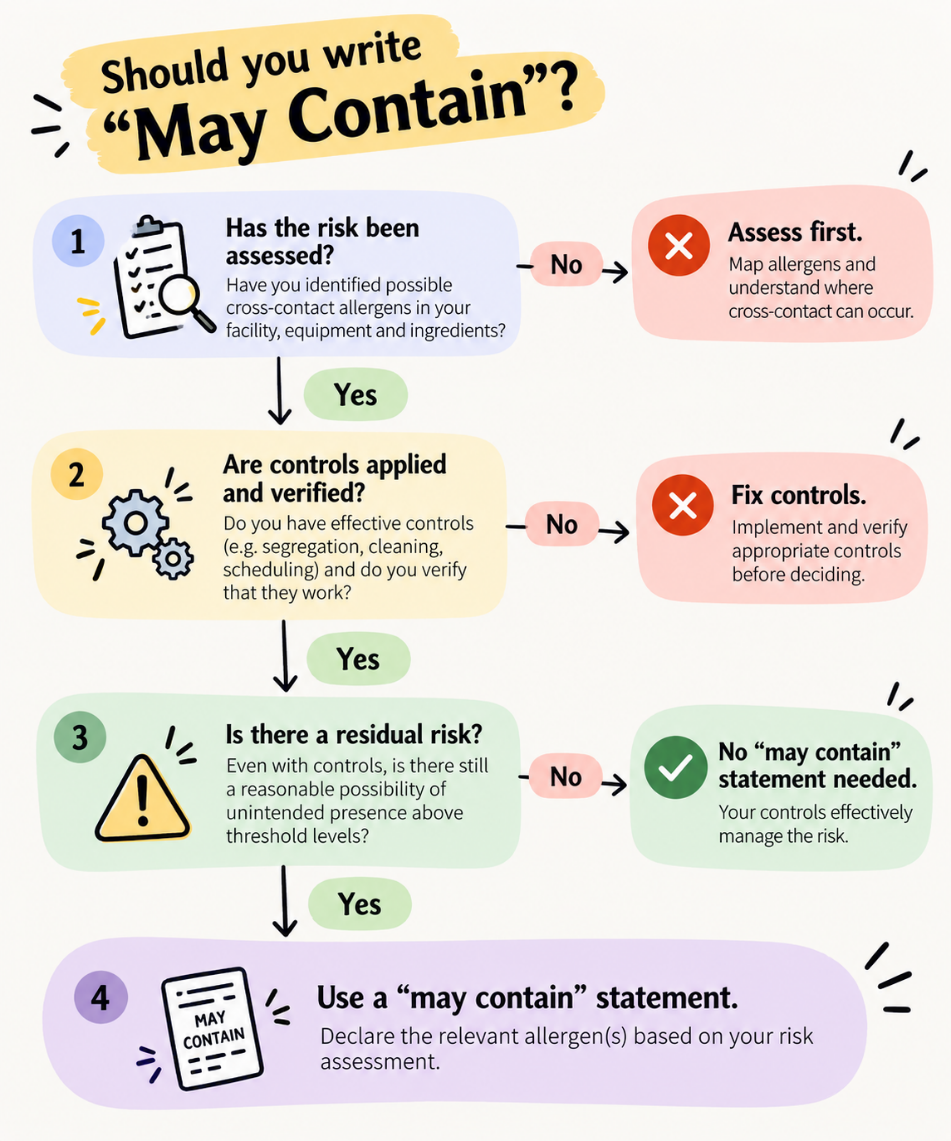
At this time FSSAI does not have a formal framework which is based on thresholds for precautionary allergen labelling, and it is therefore necessary for "may contain" to be based on a documented risk assessment rather than being used as a general disclaimer.
A defensible decision considers:
- The same cooking lines, fryers, utensils, and equipment are used.
- The cross-contact controls which are actually in place.
- Checking that those controls function.
The statement 'may contain nuts, milk, soy and wheat' when put on all products does not constitute an allergen-control system and could show that the business has not evaluated its real risk, possibly leading to an unnecessary limitation of consumer choice.
What the new Codex framework changes
In the past Codex has served as the international standard for allergen labelling; in 2024 it made it mandatory to declare the presence of sesame and promoted soy into a recommended category, changes which FSSAI has not implemented.
In July 2026 the Codex adopted as a new annex to its General Standard for the Labelling of Pre-packaged Foods a precautionary allergen labelling framework.
The framework is based on a risk-oriented method, meaning that businesses should start by putting in place allergen controls and only then evaluate the remaining risk before thinking about introducing precautionary labelling.
It also sets up reference doses for allergen proteins, with 1 mg specified for various tree nuts, 2 mg for peanut, egg, milk and sesame, 5 mg for wheat and fish, 10 mg for soy, and 200 mg for crustacea; there is a separate reference dose of 4 mg of total gluten for gluten-containing cereals.
The framework also states that precautionary information should start with "may contain" or with a similar phrase, and that the PAL does not take the place of a required "Contains:" statement when an allergen is present intentionally.
Exporters should therefore verify both the FSSAI requirements and the rules of the destination market.
Building allergen controls
A practical allergen programme starts with eight steps:
- Identify the allergens by recording all the ingredients, premixes, oils, and processing aids and getting the composition information from the suppliers.
- Trace the flow: find the fryers, mixers, conveyors, ovens, chopping boards, utensils and other points where cross-contact can occur.
- Store the allergens in sealed containers with clear labels and keep them separate. Make sure that any spills do not cause contamination of the other ingredients.
- When it comes to scheduling production, it is advisable to carry out the allergen-free products first after cleaning and then to proceed with the higher-risk products.
- Cleaned to a defined standard: state what is to be cleaned, the method to be used, the means employed and who is responsible for verifying it. A simple visual wipe does not amount to the removal of allergens.
- Regarding rework: rework that contains allergens should be returned only to the correct product.
- When verifying or modifying cleaning procedures, use visual inspections together with allergen-specific testing. ATP testing is not capable of specifically detecting allergens.
- Assign responsibility for the approval of labels and check the first batch from each production run against the current formulation.
In kitchens the use of shared fryers and the giving of allergen information solely by word remain major risks. The staff ought to make use of a written allergen chart and in the case of any uncertainty should pass the matter on to the chef or to the designated allergen lead.
Training staff
Training should make use of real products and real situations, not generic slides.
Display the employees the actual supplier specifications, go over the places where cross-contact might occur, and then see how they react to scenarios such as a customer who is allergic to peanuts ordering food from a shared preparation area.
When a new product or recipe containing an allergen is introduced or at least once every year, training of the staff should take place and retraining should be carried out following any incidents or near misses. Records should be kept showing both the content of the training and the way in which competence was assessed.
What to check this month
- Check the supplier composition sheets for the five SKUs or menu items that have the highest volume.
- Check them against the existing “Contains:” statements or allergen charts.
- Make sure to check the sulphites contained in dried fruit, vinegar and wine-based ingredients.
- Check the allergen, vegan and free-from claims on the packaging, menus, websites and specifications.
Record the reasons for each “may contain” statement.
- Include an allergen review in the supplier and recipe change procedures.
The objective is simple, namely to find out what is in the product, to avoid any unintentional contact with allergens, to communicate this information accurately and to provide training for those people who have responsibility for maintaining those controls.
Comments
No comments yet. Be the first to share your thoughts.
Add your thoughts
Contact usPrefer a call with our team? Use Contact us, or leave your email below if you want us to follow up on this comment.