
A GUIDE FOR FOOD BUSINESS FOUNDERS

A GUIDE FOR FOOD BUSINESS FOUNDERS
Prepare for your FSSAI audit without the panic
Based on 1,500+ audits · Restaurants, manufacturers, caterers, bakeries & retailers
Most food businesses do not fail audits because they lack intentions. They fail because they treat food safety as a compliance checkbox to tick once a year.
Areas where food safety audits are focused on
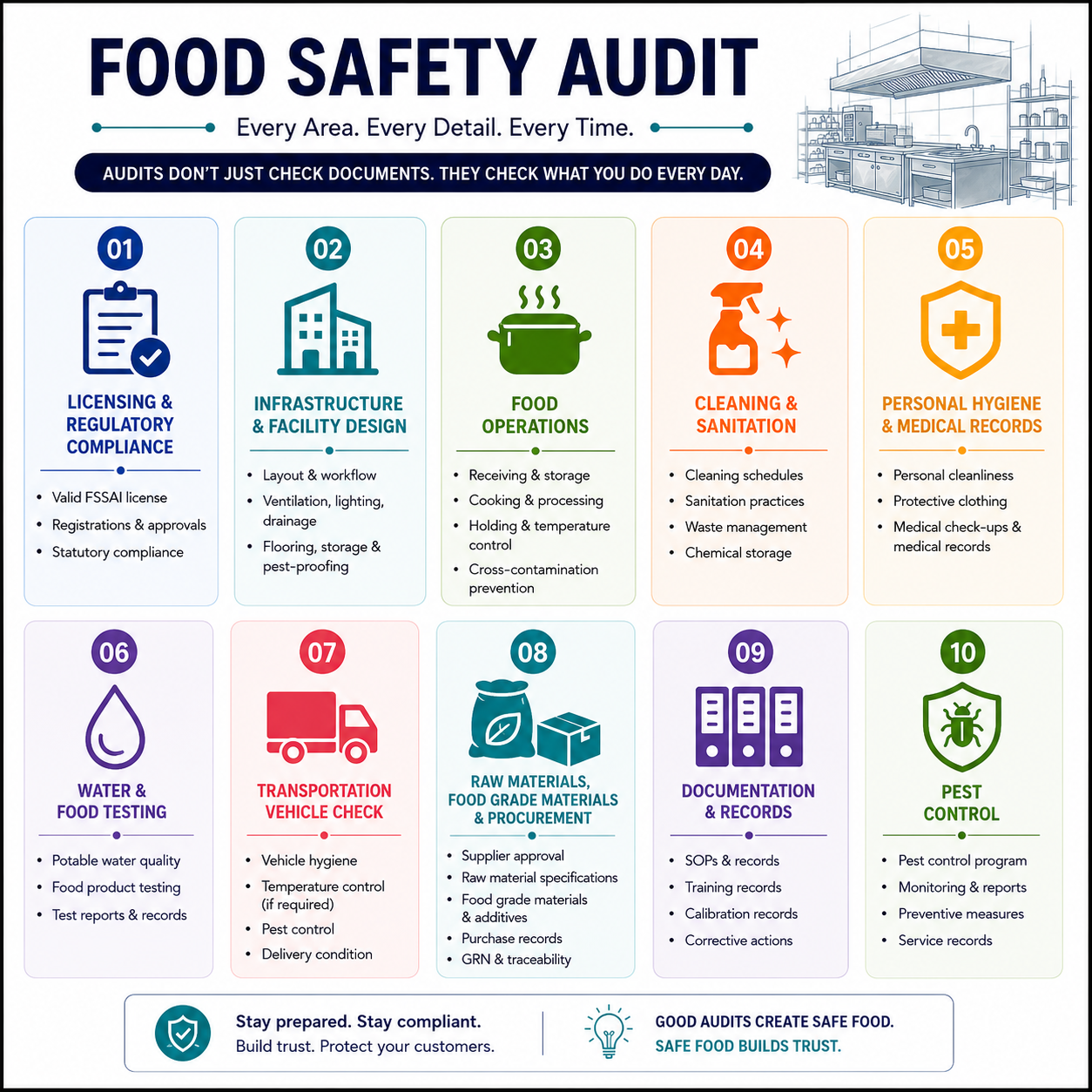
Types of audits: know what is coming
Not every audit is the same, and knowing which one is coming helps you prepare appropriately. There are three broad types.
| Type | Run by | Purpose | Required when |
|---|---|---|---|
| Internal | Your own team. | Find gaps early and stay ready between official inspections. | Ongoing, at your own discretion. |
| External | An independent third party. | Bring fresh eyes to habits your team has stopped noticing. | Often by buyers, delivery platforms or supply-chain partners. |
| Third-party FSSAI | A NABCB-accredited agency. | Formal, standards-based, recognised by FSSAI itself. | Certain categories, or formal certification. |
How you are actually scored
FSSAI inspections are not pass or fail on gut feeling. They run on a published marking system, and knowing it changes how you prepare.
Every requirement is marked Compliance, Non-Compliance, Partial Compliance (documented or implemented, but not both), or Not Applicable.
| Grade | Status | Marks |
|---|---|---|
| A+ | Compliance: Exemplar | 90 and above |
| A | Compliance: Satisfactory | 80–89 |
| B | Needs Improvement | 50–79 |
| None | Non-Compliance | Below 50 |
Which checklist applies to you
FSSAI maps specific checklists to specific kinds of business (Kob). Knowing which one applies to you tells you exactly what is coming.
| Your business | Checklist used |
|---|---|
| Restaurant, hotel, Dhaba, banquet hall, canteen, home kitchen / tiffin service | Catering |
| Food manufacturer, Relabelled, Repacked | General Manufacturing |
| Dairy / milk chilling unit | Milk Processing |
| Meat processing unit | Meat Processing |
| Slaughtering unit | Slaughter House |
| Retailer, petty snack / tea shop | Retail |
| Storage or warehouse (cold, controlled atmosphere, or ambient) | Storage & Warehouse |
| Transporter (refrigerated vans, tankers) | Transport |
| Wholesaler, distributor, marketer, supplier | Depends on activity, usually Transport, Retail or Storage |
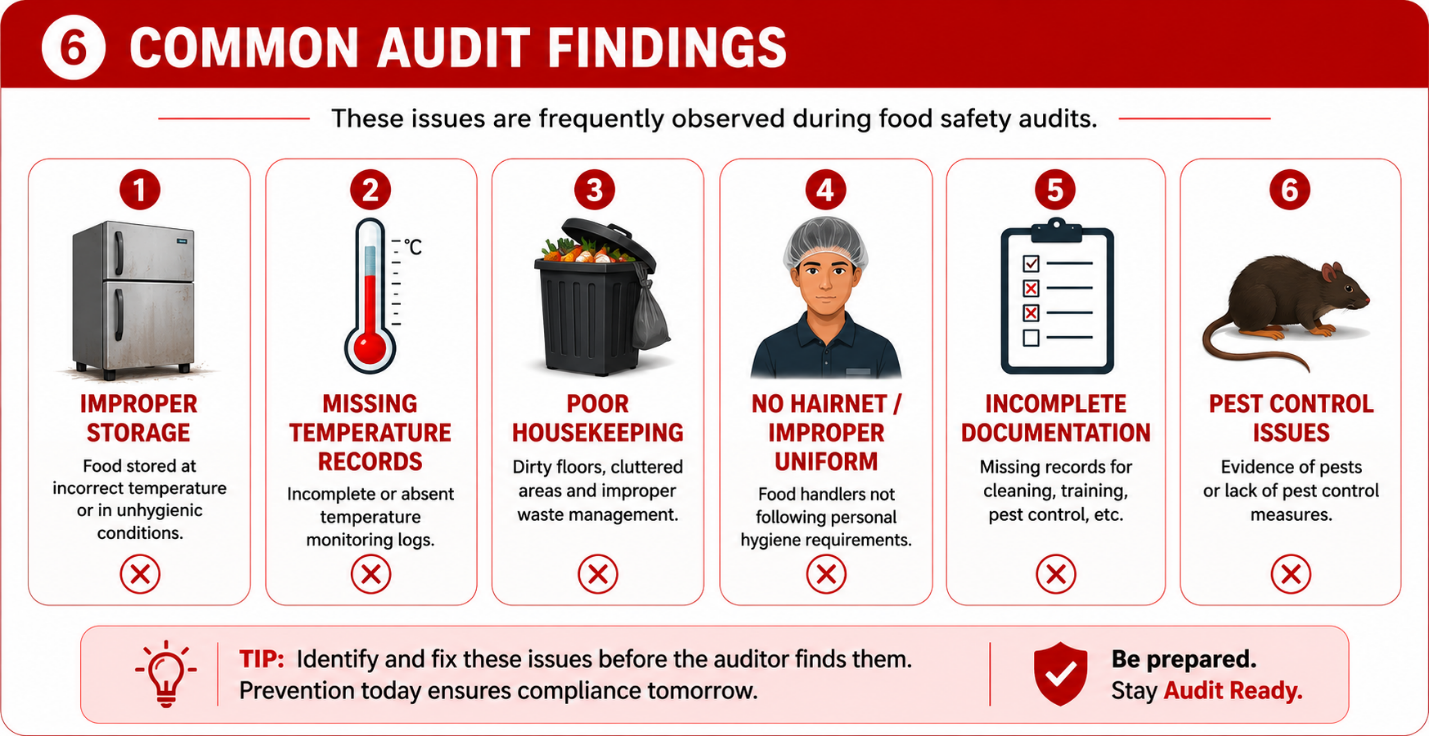
Where food businesses actually slip up
Across 1,500+ audits fresh food, manufacturers, retailers, caterers the same non-compliance appear again and again.
What actually happens after an audit
This comes straight from FSSAI’s Food Safety Auditing Regulations, 2018, which draw a hard line between two kinds of findings.
| Major non-conformity | Minor non-conformity |
|---|---|
| Reported in 24 hours | Up to 30 days to fix |
| A serious failure that could cause real harm. The auditor must report it to the Licensing Authority within twenty-four hours. | The auditor sets a correction deadline of up to thirty days and follows up; miss it and it is referred to the Licensing Authority. |
What else the regulation specifies
• Keep records for at least 5 years, not 90 days, not a year. All audit findings and corrective-action records. Five years.
• You get a chance to explain. Auditors are legally required to let you clarify before finalising any finding you are not just handed a verdict.
• Good audits reduce your inspections. Consistently satisfactory reports let licensing authorities reduce how often they inspect you at all.
• Auditors must be independent. They cannot have trained, consulted for, or audited your business in the prior two years, and cannot audit you more than three consecutive times.
How do you get audit-ready?
Readiness is not a project you complete the week before. It is a small set of habits that, once routine, mean you are simply ready.
• Keep licenses and certifications current. Expired documents are the simplest points to lose and the easiest to protect.
• Run mock audits: walk through exactly as an inspector
• Fix infrastructure issues early, not audit week.
• Update records in real time, not backfilled later.
• Train the team continuously: habits fade without reinforcement.
• Get an external walkthrough for honest feedback before the real thing.
Why this matters beyond compliance
Audit observations do not stay contained to the audit. They can trigger re-audits, delay platform approvals, erode customer or buyer trust, and in serious cases lead to closure.
Paperwork alone does not make a business safe. When the whole team understands why food safety matters, compliance stops being a checkbox and becomes a culture.
If you would like a second set of eyes
Inspect runs pre-audit assessments for restaurants, manufacturers, caterers, bakeries, retailers and dairy businesses. We walk through your specific operation, identify every gap that matters for your Kob, and give you time to fix it well before the official audit.
No generic checklist. A walkthrough built around what you actually run.
Talk to our regulatory expertComments
No comments yet. Be the first to share your thoughts.
Add your thoughts
Contact usPrefer a call with our team? Use Contact us, or leave your email below if you want us to follow up on this comment.