
The Real Cost of a Food Label Claim Mistake (Before You Print)
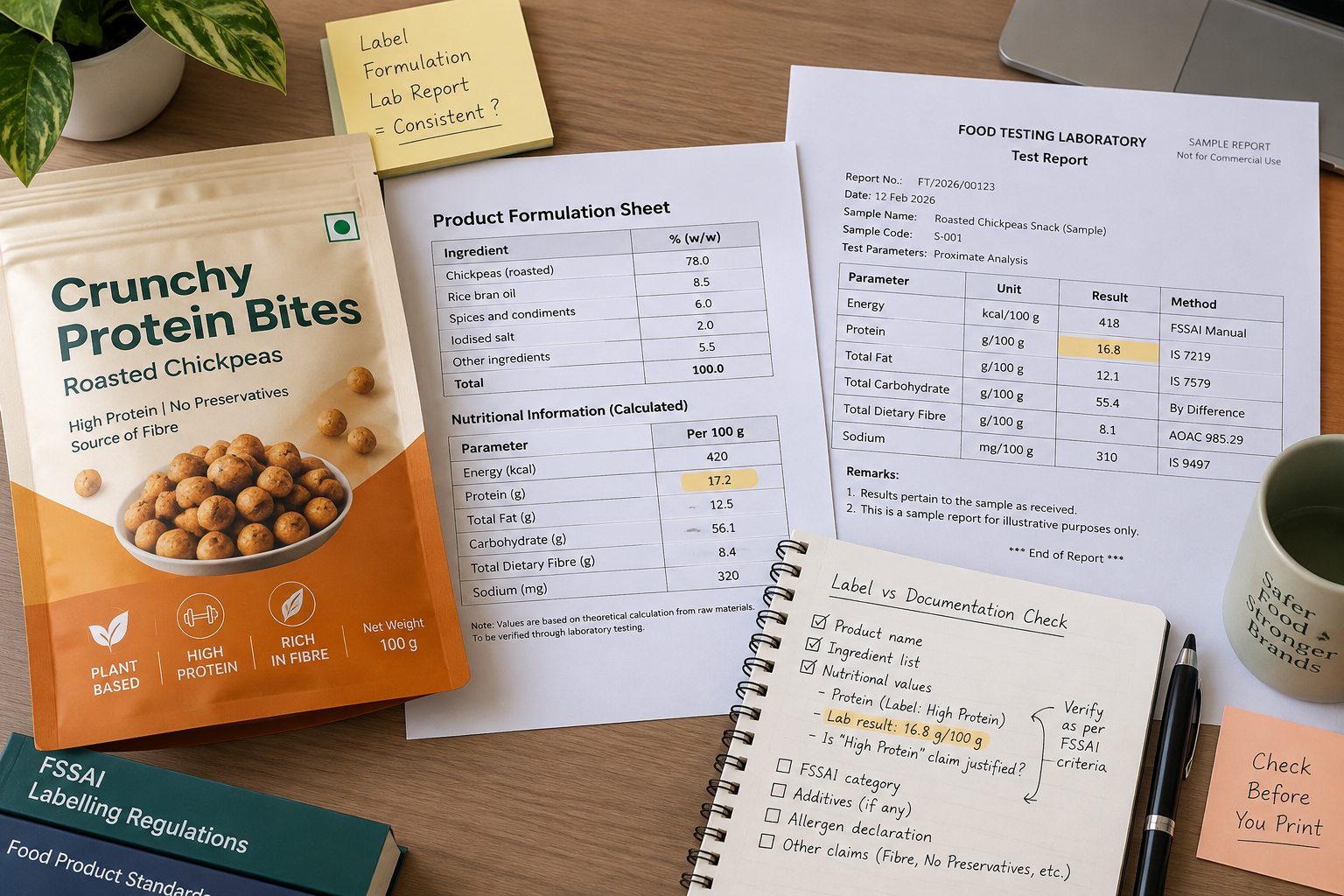
If your label says '100%,' 'healthy,' or 'pure' read this before your next print run.
Most of the label mistakes I catch aren't lies. They're words that sounded fine at the design stage and never got checked against what FSSAI actually allows: "100% Natural," "Healthy," "Pure," sitting on a pack that was signed off on taste and look, not on whether the claim can survive a regulatory read.
FSSAI's May 2025 advisory called out "100%" by name and told food businesses to drop it from labels and packaging entirely. The word is undefined in law, so it's free to imply whatever sounds strongest absolute purity, total superiority, complete composition.
Misleading advertising carries a penalty of up to ₹10 lakh; misbranded food, up to ₹3 lakh. Those are statutory ceilings, not the expected outcome of every mistake. The fine is rarely the part that actually costs you.
Why "100%" specifically got flagged
The problem with "100%" is that it has no legal meaning at all. Nothing in the Food Safety and Standards Act, Rules, or Regulations defines it, which is exactly why it can mean four different things depending on where it sits:
"100% Wheat" is a claim about composition
"100% Pure" is a claim about purity
"100% Natural" is a claim about processing
"100% Healthy" is a claim about the product's overall health value
The other words carrying the same risk
"100%" is the one that got a public advisory, but it's one entry on a longer list. FSSAI's Advertising and Claims framework (Schedule V) names natural, fresh, pure, traditional, authentic specifically, each with its own conditions:
Pure: reserved for single-ingredient foods with nothing added. A compound product with several ingredients doesn't qualify, full stop.
Natural: needs more than a short ingredient list. The formulation, the processing method, and the category conditions all have to hold up.
Fresh: tied to how little the product's been processed, not to how appealing it sounds.
Traditional / Authentic: creates an expectation about recipe, method, or origin, and needs documentation behind it if anyone ever challenges it.
What a wrong claim actually costs
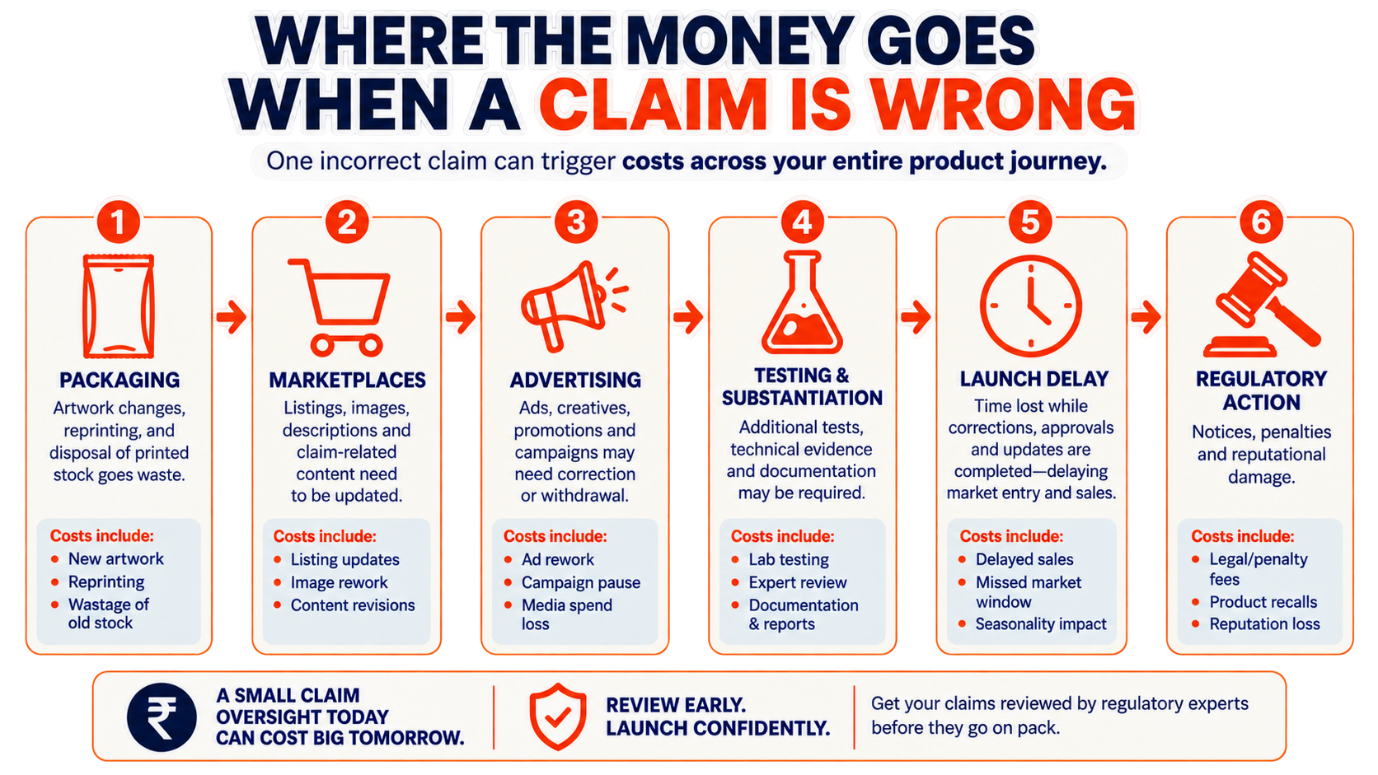
Say "100% Natural" gets flagged not at the design file stage, but after the pouches are already stacked in a warehouse and the Instagram ad is already running. Here's what that one line now costs, across every stage it's already passed through:
.
| Claim | Status | What defends it |
|---|---|---|
| 100% | Advisory: discontinue | Nothing, remove it |
| Pure | Single-ingredient foods only | Formulation proof, supplier declarations |
| Natural | Allowed with conditions | Ingredient specs, processing method |
| Fresh | Allowed with conditions | Process records, shelf-life data |
| Traditional / Authentic | Allowed with conditions | Recipe or origin documentation |
| No Added Sugar | Permitted | Formulation and ingredient records |
| High Protein / Low Fat | Permitted | Nutrition calculation meeting defined criteria |
Before the file goes to the printer
A claim check doesn't have to be complicated. Four questions catch most of what goes wrong:
What does the claim actually say, word for word? Write out the exact consumer-facing line not what you meant, what it says.
Does the formulation support it? Check ingredients and process against what the claim implies, not against how the product tastes or looks.
Is there a narrower, defined claim available instead? "High protein" usually does more work, more safely, than "healthy."
Is the claim consistent everywhere it appears? Pack, website, marketplace listing, social post, ad copy all of it has to say the same thing. Fixing the pouch and leaving the Amazon listing untouched still counts as non-compliant.
FAQ
Can I write "FSSAI Approved" on my label?
No. FSSAI licenses and registers food businesses It doesn't "approve" individual products or claims. It's one of the most common mistakes I see on packaging from newer brands, and almost always unintentional.
Is "clean label" a claim I need to defend?
"Clean label" isn't defined under the FSSAI framework, so it carries the same risk as any undefined word .It can be read to promise something specific (no additives, no preservatives, minimal processing) that the product then has to actually support.
What about "no preservatives"?
That's a non-addition claim, similar in structure to "no added sugar." It needs to be factually accurate about the formulation, not a general impression of wholesomeness.
Does a claims review need to happen before every packaging run, or just the first one?
Every run where the claim, formulation, or ingredient sourcing changed. A claim that held up for one batch doesn't automatically hold up for the next if the recipe shifted even slightly.
When this costs five minutes, and when it costs six figures
It comes down to when someone checks it, not which word is on the pack. Caught before the file goes to print, it's a quick edit. Caught after the packaging is stacked, the listing's live, and the ad is running, it's a cleanup job across six different places.
Inspeckt Food Solutions reviews food claims, brand names, and labels for FSSAI compliance before they go to print, not after.
Have a packaging run coming up? Get the claim checked first.Comments
No comments yet. Be the first to share your thoughts.
Add your thoughts
Contact usPrefer a call with our team? Use Contact us, or leave your email below if you want us to follow up on this comment.